Updated on
Summary US supports current trilateral talks between Pakistan, Iran and Afghanistan.
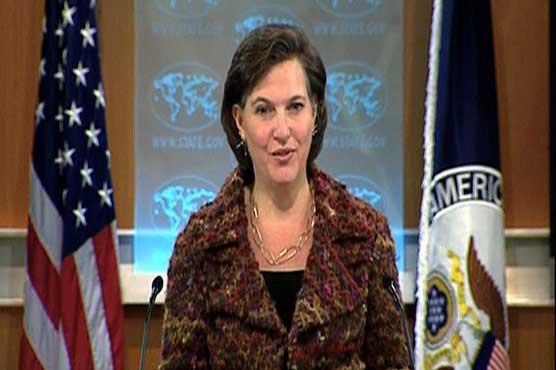
The spokesperson of the US State Department, Victoria Nuland has said that the United States supports the ongoing trilateral summit, involving Pakistan, Afghanistan and Iran, in Islamabad despite having reservations on Irans nuclear programme and its support for terrorism in the region. We are not trying to get in the way of good neighbourly relations if, in fact, they support a democratic, peaceful, stable Afghanistan. We’ve said from the beginning we are not trying to stop legitimate trade in food, medicine, these kinds of things, between Iran and its neighbours, she emphasised.What we obviously object to is the attitude of Iran to its nuclear obligations, its support for terror, particularly support for terror in its neighbourhood. So the degree to which Iran, Pakistan, and Afghanistan are talking about positive support for an increasingly democratic Afghanistan, that would be in keeping with the goals of the New Silk Road Project that we support.But if there are difficult issues between them, this is an opportunity to deal with those too. And as you know, there have been concerns about some of Iran’s behaviour inside Afghanistan, she observed.On another question about indications that Iran was seeking to be a player in the reconciliation talks with Taliban, she said we’ve said all along that we think all of the neighbours need to support this process and the regional states need to support this process if it’s going to be successful. That’s what President Karzai has also called for.With regard to whether there’s a role to be played by Iran, frankly, I think the main thing would be to encourage Afghans to talk to Afghans as another step in the reconciliation process. You know that Iran has participated constructively in some of the recent international meetings that we’ve had to support the Afghans in general. They were part of the Istanbul group in November and they were present at the New Silk Road Initiative in September at the UN. They are neighbours. That said, we don’t necessarily support all the things that they have been known to be up to inside Afghanistan, Ms. Nuland went on to explain.When asked about conflicting statements from Afghan president Hamid Karzai and Taliban about three-way meetings between Taliban, US, and Afghanistan officials, she declined to offer any details. We don’t think it’s for us to get into the blow-by-blow of how we are trying to facilitate a process that gets to Afghans talking to Afghans about peace, reconciliation, and stability there. So I’m frankly not going to get into who met whom where and in what configuration, she stated.What we did think was interesting about the press statements we saw from President Karzai is that he is again making very positive statements about the process, making clear that he and his government are prepared to be actively engaged and working with others on that. So he also – President Karzai – makes the point that he’s not going to give all the details either, because the folks trying to work this through need some space to see if the process can work, she argued.She also brushed aside Taliban spokesmans claim that they had not met anybody. There are lots of Taliban saying lots of different things. So again, we’ve said and the Secretary has made clear this whole process is at a very preliminary stage. We’re still at the stage of trying to build the trust among the Afghans so that they can sit in the room and have conversations. So that’s the stage that we’re at, and it’s very, very preliminary, she asserted. She also refused to comment on a query whether Taliban leader, Mullah Omer was supporting these talks.When asked if the US was playing an honest broker role in these talks, she said there are some Taliban who are willing to talk to us. We obviously talk to the Afghans. We’re trying to get to a place where, through our good offices, other good offices, they start talking to each other.From our perspective, this preliminary effort to get the sides to meet directly and meet with each other continues. You’re going to have lots of stray press comments from different factions, different groups, throughout this process. We all just need to be steady and take it one step at a time, she opined.On another question by an Indian journalist regarding the participation of banned outfits in Difa-i-Pakistan rally in Karachi, the State Department expressed concern saying that the US government is concerned about the recent public appearances of Jamaat-ud-Dawa leader Hafiz Saeed, including at a recent rally in Karachi. Lashkar-e-Taiba, and its front group Jamaat-ud-Dawa, is internationally sanctioned because of its associations with Al Qaeda. We have and continue to urge the Government of Pakistan to uphold its obligations in accordance with UN Security Council Resolution 1267/1989.That resolution calls for all countries to freeze assets of sanctioned groups, prevent the transfer of arms to them, and prevent sanctioned individuals from entering or transiting their territories.There was also an interesting back-and-forth between the reporters and the State Department spokesperson on Egypt during the briefing, when she was asked whether the administration was disappointed that Egypt’s political parties don’t seem to be helping the US, and there was apparently a concerted effort to whip up anti-American sentiment. That is concerning. That is very concerning, Ms. Nuland conceded.Upon this a journalist remarked, it just seems that this – that Egypt has turned into Pakistan here overnight in – as it relates to U.S. aid and assistance and involvement. And this is a country, Egypt, which has gotten nothing but benefit from us. There’s – there can’t – there are no complaints about drone strikes, there’s no complaints about contractors or embassy workers killing people on the streets of Karachi. There’s nothing like that. There’s no bombings that are killing 24 Egyptian soldiers going on, and yet you have a situation that’s almost parallel to that in the anti-American sentiment that’s being whipped up after having spent billions and billions of dollars, probably even more than has been spent in Pakistan. Is that a concern?Ms. Nuland, without dilating on the analogy used by the said journalist, said it is a concern that this kind of false information that’s being put out about what our NGOs do, the role that they have wanted to play and have been active in playing, in supporting the superb elections that the Egyptians have already had, and still need to have going forward, is being mischaracterized in a way that is casting a pall over the value of the relationship as a whole between Egypt and the United States, which we think is of strategic value to us and we would very much like to continue to play a role in supporting not only the security and stability of Egypt but very much it’s democratic transition.- Contributed by Awais Saleem, Dunya News correspondent in Washington, DC