Updated on
Summary Chiniot Police tortured women protesting against murder of a groom on his wedding day.
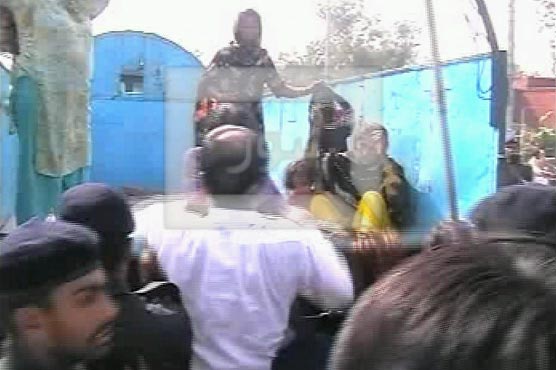
The policemen Saturday exhibited brazen cruelty by torturing women of the family that has lost their dear one to the firing of a constable, Nasrullah, on his wedding day. As if the murder on the wedding day was not enough of a tragedy that Chiniot police crossed all limits of inhumane treatment by kicking and thrashing the women of the family.The women were protesting against the murder of Anwar Ali by placing his dead body in front of the DPO office as a way to press justice. But what the cops did on orders from the sturdy DPO has shamed all who believe in the rule of law.Such inhumane were the policemen that they threw the protesting women in a truck as if they were animals. Even animals won’t be treated that way in the civilized world. But what to talk of civilization in a country where the custodian of people’s lives take law in their hands under the pretext of maintenance of public order. Most of such cruel cops and officers escape with a slap on the wrist in the form of their suspension that too is mostly meant to hoodwink the people by diverting their attention.Policemen slapped and baton-charged the women in board daylight in front of TV cameras. Their highhandedness reflected that the high-ups had mandated them to trample on all principles of respect for women.The sister-in-law of deceased Anwar Ali said that police subjected her to worst cruelty and threatened her with dire consequences if she sought justice.On the other hand, the DPO, Shahzad Akbar, invoked a novel excuse to justify torture. He said the whole of the deceased’s family is criminal. He said the family has hundreds of cases registered against them.In no different remarks, Punjab Law Minister Rana Sanaullah said that only inquiry would prove if policemen crossed the limits; as if the TV footages weren’t speaking of torture.The law however clearly states that any accused is to be considered innocent until proven guilty in a court of law.