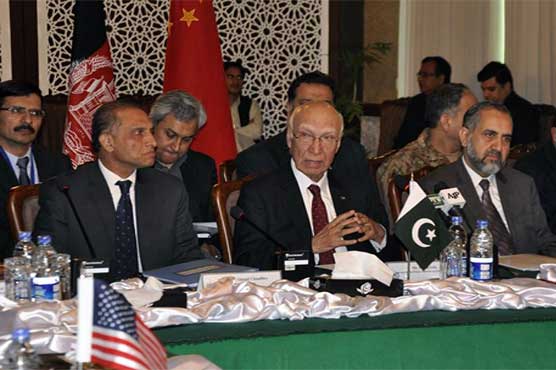
Summary Sartaj Aziz addressed the opening ceremony of fifth round of dialogue on Afghanistan in Islamabad.
ISLAMABAD (Web Desk / AFP) - Adviser on Foreign Affairs Sartaj Aziz on Friday said that Quadrilateral Coordinating Group is making sincere efforts to ensure peace and stability in Afghanistan.
Addressing the opening ceremony of fifth round of dialogue on Afghanistan in Islamabad, the adviser said that joint efforts of the group are vital for establishing peace in Afghanistan.
He said Pakistan has played a vital role in holding a meeting of the group in Murree last year and dispelled the impression of some countries that Pakistan is controlling the Afghan Taliban. He said no positive response was received from Afghan Taliban despite best efforts of Pakistan.
He said the dream of regional connectivity is impossible without establishing peace in Afghanistan.
He said the fifteen years military operation in Afghanistan has produce no substantial results and a peaceful, stable and prosperous Afghanistan is in the interest of Pakistan.
Sartaj Aziz said strongly condemned the recent terrorist attack in Afghanistan and called for an effective border security system.
He made it clear that Afghan refugees will be voluntarily repatriated to their homeland.
Pakistan is hosting four-nation meeting aimed at reviving long-stalled direct peace talks between the Afghan government and Taliban insurgents.
The latest meeting of representatives from Afghanistan, the United States, China and Pakistan comes days after Afghan authorities hanged six Taliban-linked militants, the clearest sign to date of Kabul’s mounting frustration at the lack of progress.
The four-nation group was formed in January to try to restart the direct peace talks. But the lack of a breakthrough has left many frustrated as the Taliban have intensified their insurgency, launched in late 2001 after they were toppled from power by a US-led invasion.
On Wednesday a senior Afghan official sounded a more optimistic note.
"We are hopeful this time after we had complaints regarding Pakistan, over not bringing the Taliban to the negotiation table. There is pressure on Pakistan by the US and China, the important participants of the talks," Mawlawi Shahzada Shahid, a spokesman for a group called the High Peace Council, told AFP in Kabul.
He added that a visit in April to Pakistan by a senior Taliban delegation from their political office in Qatar had further raised hopes.
"Pakistan had somehow convinced them to come back to the talks, and I believe there will be progress and development this time around," Shahid said.
Direct Afghan-Taliban talks began last summer but ended abruptly after it was revealed that the Taliban’s founder Mullah Omar had been dead for two years, sparking infighting among the insurgents.
The group has made the withdrawal of the 13,000 foreign troops still in Afghanistan a precondition for talks.