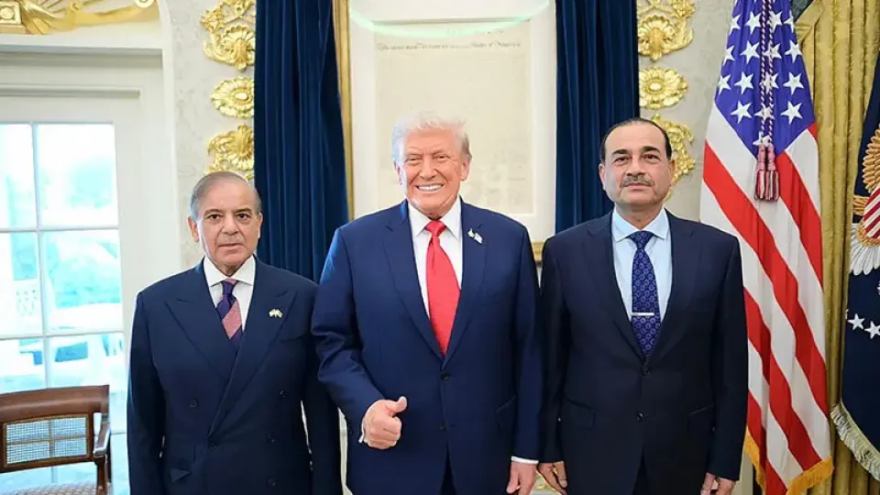
Summary Donald Trump praises Pakistan’s leadership, including PM Shehbaz Sharif and Field Marshal Asim Munir, after extended Islamabad talks with Iran while reaffirming his stance on the Strait of Hormuz
WASHINGTON (Dunya News) – US President Donald Trump has strongly praised Pakistan’s leadership, commending Prime Minister Shehbaz Sharif and Chief of Defence Forces Field Marshal Asim Munir for their role in facilitating high-level negotiations between the United States and Iran in Islamabad, as diplomatic engagement continued over a prolonged 21-hour session.
Trump highlighted Pakistan’s efforts in hosting and mediating the discussions, describing the civil-military leaders as “kind”, “very competent” and instrumental in enabling structured dialogue between both delegations. He noted that the talks were conducted in a highly coordinated format involving expert-level exchanges, written proposals and multiple rounds of direct engagement.
The US President’s remarks came alongside his renewed focus on maritime security in the Gulf region, including his earlier announcement regarding the Strait of Hormuz, one of the world’s most critical energy transit routes.
Pakistan role
According to Trump’s statement, he was fully briefed on the Islamabad discussions by senior US officials following the extended negotiations, which involved detailed deliberations on Iran’s nuclear programme, sanctions, frozen assets and broader regional security arrangements.
https://t.co/PSaltyXHlI pic.twitter.com/G005C1vbo5
— Rapid Response 47 (@RapidResponse47) April 12, 2026
US Vice President JD Vance, who led the American delegation, also acknowledged Pakistan’s contribution, stating that Islamabad had played an “amazing” role in attempting to bridge differences between Washington and Tehran. He emphasised that Pakistan’s facilitation efforts were central to keeping dialogue structured throughout the extensive sessions.
Iran’s delegation, led by Parliament Speaker Mohammad Bagher Ghalibaf, similarly expressed appreciation for Pakistan’s hosting of the talks, referring to Islamabad as a “friendly and brotherly country” that supported sustained diplomatic engagement.
Islamabad talks
The Islamabad talks spanned more than 21 hours, beginning on Saturday afternoon and continuing into Sunday morning, with both sides engaging in multiple rounds of structured negotiations. Expert teams exchanged written texts after each session, signalling a detailed and technical negotiation process.
The agenda covered key issues including Iran’s nuclear programme, sanctions relief mechanisms, frozen assets and regional stability. While differences remained on core issues, both sides engaged in what officials described as substantive and forward-looking discussions.
Trump, in his statement, noted that several points of understanding were reached during the process, while reiterating that the primary concern remained Iran’s nuclear ambitions. He stated that Washington’s position continues to focus on ensuring long-term non-proliferation commitments.
Strait of Hormuz
Separately, Trump reaffirmed his earlier announcement regarding the Strait of Hormuz, underscoring Washington’s position on maritime security and freedom of navigation in the region. He had previously directed the US Navy to take measures related to vessel movement through the strategic waterway.
He reiterated that any arrangement undermining safe passage through international shipping lanes would be addressed firmly, while maintaining that global trade routes must remain secure and unobstructed.
Trump orders immediate blockade of Strait of Hormuz after stalled US-Iran talks in Islamabad
The Strait of Hormuz remains one of the most significant maritime corridors globally, connecting the Persian Gulf to the Gulf of Oman and carrying a substantial portion of the world’s oil shipments.
US-Iran delegations leave Pakistan
Both US and Iranian delegations credited Pakistan for its role in enabling extended engagement between the parties. The format included multiple sessions, expert consultations and structured exchanges, reflecting an organised diplomatic effort aimed at narrowing differences.
Following the talks, US officials, including Vice President Vance, departed Islamabad after acknowledging Pakistan’s hospitality and mediation efforts. The American side reiterated that communication channels remain open as discussions continue at diplomatic level.