Updated on
Summary Abd Al-Rahim Al-Nashiri, appeared for arraignment hearing before a commission at Guantanamo Bay.
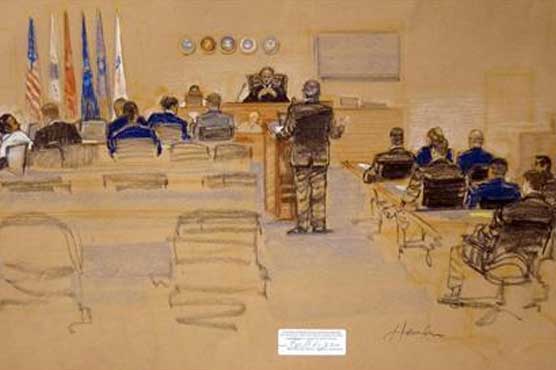
The main accused of the USS Cole bombing, Abd Al-Rahim Hussyn Muhammad Al-Nashiri, appeared for arraignment hearing before a military commission at Guantanamo Bay detention center Wednesday.Al-Nashiri, born in Saudi Arabia, is charged of masterminding USS Cole bombing in 2000 that killed 17 US sailors and injured 39 others.He is also accused of Limburg tanker bombing and other alleged terrorist attacks. He was arrested in UAE in 2002 and was allegedly heading al-Qaeda operations in the Persian Gulf and the Arabian Peninsula prior to his arrest.Al-Nashiri’s trial has assumed great significance because he is the first Guantanamo Bay detainee who is facing death penalty on account of charges against him, if proved guilty. The prosecution was supposed to read out all the charges to him at the hearing, but the judge waived that part with the consent of defense team.The defense had filed three motions before the arraignment, which took most of the time as both sides presented their arguments. The first motion of the defense was regarding the intention of US officials made clear through public statements that Al-Nashiri will not be released even in case of acquittal. “Realities can change. Two years ago, there’s talk of closing down Gitmo, and now we are here again”, said the judge on a lighter note.However, the judge did ask the prosecution “how can one be held captive indefinitely”? The prosecution argued that the defense team was making assumptions about a situation, which had not arrived yet. On the insistence of the judge, the prosecution did concede “there is no legal bar on Al-Nashiri to walk free after acquittal, if hostilities end”. The judge denied the defence motion and directed that it will be taken up at the right time.Defense also requested ex-parte assistance from convening authority for submission of evidence and assistance of experts without bringing it in the knowledge of the government. They argued that they “feared disclosure of defence practices”. Prosecution showed reservations on how this could be used by defence. The judge later agreed to a suggestion by Defence attorney to draft a letter jointly with the trial counsel for sending to convening authority (i.e. government) and gauge reaction before giving a decision.On the third motion, regarding screening of attorney’s mail to the detainee, a fierce battle of arguments ensued spanning over two hours.The defence counsel termed it a breach of the attorney-clent privilege while the prosecution maintained it was necessary to “protect national security and safety interests”.The judge ruled in favour of Defence motion on this point and asked them to clearly mark correspondence as privilege mail on envelope and each paper in the mail. They could get together with Guantanamo’s Joint task Force (JTF) officials to devise a mechanism in this regard, the judge asserted while adding that “the JTF will only look at the marking and not the content of the mail”. “Other unauthorized material like magazines etc, marked as privilege mail, may be seized by JTF”, he observed.Nashiri, 46, appeared calm during the proceedings and also reserved his right to plea (guilty or innocence) in the hearing to a later date, when the judge, Mr. John C. Pohl, asked him how he would like to plead in the case. He was given the services of an Arabic translator as the judge explained his rights and the legal course to him.Richard Cammon led the defense team for Al-Nashiri while the lead trial counsel for the prosecution was Lt. Commander, Andrea Lockhart. Both sides agreed that Nashiri would not be subjected to any physical custody in the courtroom, as he appeared in his white jail uniform before the court.The judge, though, explained to him that he could wear civilian clothes if he so desired when the jury stage of the trial will begin, in case he thought that jail dress could provoke some negativity amongst the jury against him. The defense counsel also questioned the judge on his qualification to hear the case and his views on death penalty.After the presentation of arguments on all three motions and completion of arraignment process, the judge asked the prosecution how much time they wanted to present their case. The trial counsel said that they could do so on February 2nd 2012 while the defence counsel pointed out that they required at least a year to respond after going through all the evidence presented.The judge would notify a further date of hearing at a later stage. However, he ruled that a hearing in his chamber with both counsels to discuss the case and custody issues etc. of evidence would take place in January 2012. He also informed Al-Nashiri that court proceedings could go on, even in case of his voluntary absence. The accused though affirmed that he intends to attend all the sessions.The special counsel of the US department of justice, human rights activists, families of the USS Cole bombing victims and members of the general public also witnessed the hearing at Guantanamo as well as two other locations at Fort Meade in Maryland and Norfolk, Virginia with close circuit cameras.Orders from Obama administration in late 2008 to suspend all Guantanamo military Commission hearings for 120 days were over-ruled by the judge in Al-Nashiri case. The charges against him were dropped in February 2009 but the charges have been reinstated now. He has already been sentenced to a death penalty by a Yemeni court in 2004.Talking to media after the hearing, defense attorney, Richard Cammon, said that the decision in this case could take years and also complained about the loopholes in the military’s court procedures that made delays unavoidable. “We are not responsible for the previous 11 years”, he stated while emphasizing “hurried or unfair justice is a false sense of closure”. When asked if Al-Nashiri had shown any remorse on his alleged actions, he said “Nashiri is not a person without heart or feelings” without giving any clear answer. He also pointed out “he can’t imagine in current political environment that any US president will authorize his release, even after acquittal”.Chief Prosecutor, Mark Martins read out a message stating “charges had been publicly announced against a person who carried out attacks against US citizens”. “He planned boats operation with Osama bin Laden and 23 others, and handled al-Qaeda operations”. “We must use all powers to counter transnational terrorism. For families and friends of victims, nothing can bring loved ones back, but we are committed to bring those to justice under the law and provide accountability”, he opined.John Clodfelter and Saundra Flanagan spoke on behalf of the affected families and hoped that “decision in the case will bring some sense of closure in their grief”. “It was pitiful to see Nashiri because he has not gotten away with his crime and he deserves a death penalty if not worse”, they maintained. “We hope and pray that some day we have an end of it”, they said in a somber tone.- Contributed by Awais Saleem, US correspondent of Dunya News