Updated on
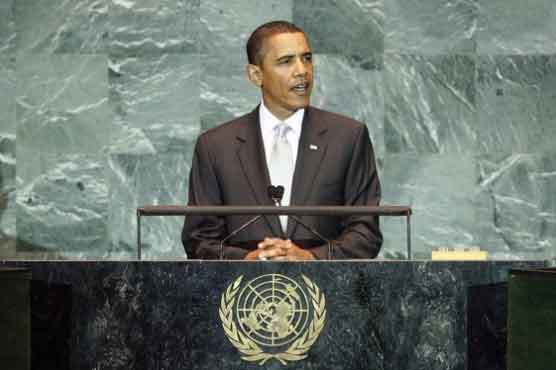
Summary Obama told UN on Wednesday there was no substitute for Israeli-Palestinian negotiations or shortcut.
With US credibility and influence in the Middle East at stake, Obama wants to dissuade the Palestinians from asking the UN Security Council for statehood in defiance of Israeli objections and a US veto threat. But they have shown no sign of renouncing their plan to stake their claim on Friday.Flag-waving Palestinians filled the squares of West Bank cities to rally behind the statehood initiative.A year after telling the UN General Assembly he hoped to see a Palestinian state born by now, the US president said creating such a state alongside Israel remained his goal.But the question isnt the goal we seek -- the question is how to reach it. And I am convinced that there is no short cut to the end of a conflict that has endured for decades, Obama said.Peace will not come through statements and resolutions at the U.N. -- if it were that easy, it would have been accomplished by now, he said.Ultimately, it is Israelis and Palestinians who must live side by side. Ultimately, it is Israelis and Palestinians -- not us -- who must reach agreement on the issues that divide them: on borders and security; on refugees and Jerusalem, he added.However, it is the failure of 20 years of US-brokered negotiations that has driven Palestinian President Mahmoud Abbas to take his quest for statehood to the United Nations -- a move that threatens to embarrass the United States by forcing it to protect its Israeli ally against the tide of world opinion.And although Obama said he had set out a new basis for negotiations in May, chances of reviving peace talks look bleak.The two sides are far apart. The Palestinians are divided internally and Obama will not want to risk alienating Israels powerful US support base by pressing for Israeli concessions as he enters a tough re-election battle next year.Yasser Abed Rabbo, a senior Palestinian official, said Obamas remarks showed an inconsistent approach in praising Arab struggles for freedom, while making an abstract call for negotiations between Israelis and Palestinians.We expected to hear that the freedom of the Palestinian people was the key for the Arab spring, he said.The Palestinians see statehood as opening the way for negotiations between equals. Israel says the Palestinian move aims at de-legitimizing the Jewish state.The drama at the United Nations is playing out as US, Israeli and Palestinian leaders all struggle with the fallout from Arab uprisings roiling the Middle East.Obama pledged support for Arab democratic change, called for more UN sanctions against Syrian leader Bashar al-Assad and urged Iran and North Korea to meet their nuclear obligations -- twin standoffs that have eluded his efforts at resolution.There is a future of greater opportunity for the people of these nations if their governments meet their obligations. But if they continue down a path that is outside international law, they must be met with greater pressure and isolation, he said.Iran freed two Americans held for spying, a day before President Mahmoud Ahmedinejad addresses the United Nations. The Iranian leader has described it as a compassionate release.Obama later met Israeli Prime Minister Benjamin Netanyahu and assured him that efforts to impose peace on Israel and the Palestinians would not work. Netanyahu said the Palestinian bid for U.N. recognition of statehood will not succeed.Obama was also due to meet Abbas and appeal to him not to present U.N. Secretary General Ban Ki-moon with a membership application on Friday, setting the stage for an eventual Security Council vote that Washington says it will block.In one of several frantic efforts to avert a diplomatic disaster, French President Nicolas Sarkozy urged the United Nations to grant the Palestinians the status of observer state, like the Vatican, while outlining a one-year roadmap to peace.Today we are facing a very difficult choice, he said.Each of us knows that Palestine cannot immediately obtain full and complete recognition of the status of United Nations member state. But who could doubt that a veto at the Security Council risks engendering a cycle of violence in the Middle East?The United States, Russia, the European Union and the United Nations -- the Quartet of Middle East mediators – are seeking a compromise, with no signs yet of success.The Security Council could also delay action on Abbas request for weeks, giving the Quartet more time to come up with a statement that could coax both sides back to the table.Whatever happens at the United Nations, Palestinians will remain under Israeli occupation and any nominal state would lack recognized borders or real independence and sovereignty.It is a measure of their desperation that they seem determined to press on with an initiative that could incur financial retribution from Israel and the United States.Israeli Finance Minister Yuval Steinitz threatened on Tuesday to stop transferring tax revenues to the Palestinian Authority if Abbas persists with his U.N. move.The money, collected by Israel on behalf of the PA, amounts to about $135 million a month, or 40 percent of the PA budget.The United States gives the Palestinian Authority financial support worth $500 million a year. Some US politicians have said they will try to cut American aid to the Palestinians if they do not give way.