Updated on
Summary An explosion shattered a building housing a nuclear reactor on Saturday, amid fears of a meltdown.
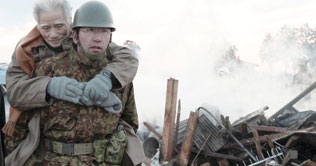
Across wide swaths of northeastern Japan, officials searched for thousands of people missing more than a day after a devastating earthquake and tsunami. The confirmed death toll from Fridays twin disasters was 686, but the governments chief spokesman said it could exceed 1,500. Devastation stretched hundreds of miles (kilometers) along the coast, where thousands of hungry survivors huddled in darkened emergency centers cut off from rescuers, electricity and aid.The scale of destruction was not yet known, but there were grim signs that the death toll could soar. One report said four whole trains had disappeared Friday and still not been located. Others said 9,500 people in one coastal town were unaccounted for and that at least 200 bodies had washed ashore elsewhere.Atsushi Ito, an official in Miyagi prefecture, among the worst hit states, could not confirm those figures, noting that with so little access to the area, thousands of people in scores of town could not be contacted or accounted for. Our estimates based on reported cases alone suggest that more than 1,000 people have lost their lives in the disaster, Chief Cabinet Secretary Yukio Edano said. Unfortunately, the actual damage could far exceed that number considering the difficulty assessing the full extent of damage.Among the most worrying developments were concerns that a nuclear reactor could melt down. Edano said Saturdyas explosion was caused by vented hydrogen gas and destroyed the exterior walls of the building where the reactor is, but not the actual metal housing enveloping the reactor. Edano said the radiation around the Fukushima Dai-ichi plant had not risen after the blast, but had in fact decreased. Virtually any increase in ambient radiation can raise long-term cancer rates, and authorities were planning to distribute iodine, which helps protect against thyroid cancer.Authorities have also evacuated people from a 12-mile (20-kilometer) radius around the reactor. The explosion was caused by hydrogen interacting with oxygen outside the reactor. The hydrogen was formed when the superheated fuel rods came in contact with water being poured over it to prevent a meltdown. The explosion was preceded by puff of white smoke that gathered intensity until it became a huge cloud enveloping the entire facility, located in Fukushima, 20 miles (30 kilometers) from Iwaki. After the explosion, the walls of the building crumbled, leaving only a skeletal metal frame.Tokyo Power Electric Co., the utility that runs the Fukushima Dai-ichi plant, said four workers suffered fractures and bruises and were being treated at a hospital.The trouble began at the plants Unit 1 after the massive 8.9-magnitude earthquake and the tsunami it spawned knocked out power there, depriving it of its cooling system. Power was knocked out by the quake in large areas of Japan, which has requested increased energy supplies from Russia, Russias RIA Novosti agency reported. The concerns about a radiation leak at the nuclear power plant overshadowed the massive tragedy laid out along a 1,300-mile (2,100-kilometer) stretch of the coastline where scores of villages, towns and cities were battered by the tsunami, packing 23-feet (7-meter) high waves.His rig ruined, he joined the steady flow of survivors who walked along the road away from the sea and back into the city on Saturday. Smashed cars and small airplanes were jumbled up against buildings near the local airport, several miles (kilometers) from the shore. Felled trees and wooden debris lay everywhere as rescue workers coasted on boats through murky waters around flooded structures, nosing their way through a sea of debris. Late Saturday night, firefighters had yet to contain a large blaze at the Cosmo Oil refinery in the city of Ichihara. According to official figures, 642 people are missing and missing 1,426 injured.Prime Minister Naoto Kan said 50,000 troops joined rescue and recovery efforts, aided by boats and helicopters. Dozens of countries also offered help. President Barack Obama pledged U.S. assistance following what he called a potentially catastrophic disaster. He said one US aircraft carrier was already in Japan and a second was on its way.More than 215,000 people were living in 1,350 temporary shelters in five prefectures, the national police agency said.Aid has barely begun to trickle into many areas.Since the quake, more than 1 million households have not had water, mostly concentrated in northeast. Some 4 million buildings were without power. About 24 percent of electricity in Japan is produced by 55 nuclear power units in 17 plants and some were in trouble after the quake. Japan declared states of emergency at two power plants after their units lost cooling ability. Although the government spokesman played down fears of radiation leak, the Japanese nuclear agency spokesman Shinji Kinjo acknowledged there were still fears of a meltdown.