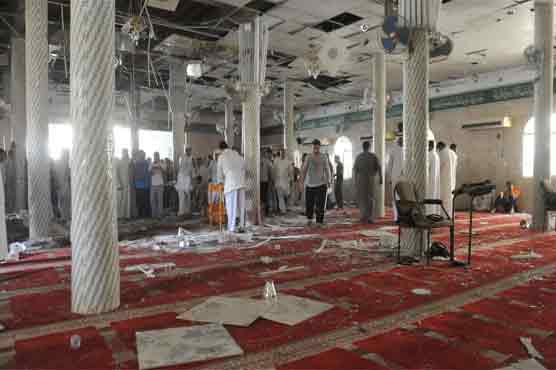
Summary An IS group suicide bomber attacked an imambargah in Saudi Arabia, killing at least 21 people.
RIYADH (AFP) - An Islamic State group suicide bomber attacked an imambargah in Saudi Arabia on Friday, killing 21 people and wounding 81 in an assault that threatens to fan sectarian tensions.
The bomber struck during the main weekly prayers in Eastern Province, where assailants linked to the extremist IS killed seven members of the Shia community in November.
The interior ministry said a suicide bomber detonated a bomb at the mosque in Kudeih, in the Shia majority city of Qatif, the official SPA news agency reported.
"An individual detonated a bomb he was wearing under his clothes during Friday prayers at Ali Ibn Abi Taleb mosque in Kudeih in Qatif," the ministry spokesman said in a statement.
The health ministry was quoted by SPA saying that 21 people were killed and 81 wounded, including 12 in critical condition.
IS said it was behind the attack, the first time the group has officially claimed an attack in Saudi Arabia, and vowed "dark days ahead" for Shias until militants "chase them from the Arabian Peninsula".
IS considers Shias as heretics.
A statement published online said "soldiers of the Caliphate" were behind the attack by Abu Amer al-Najdi who "detonated an explosives belt" in the mosque.
The United States condemned the bombing, but White House spokesman Josh Earnest said it was not immediately able to confirm it was the work of IS.
Iran demanded that the perpetrators be found and punished, and its Lebanese ally Hezbollah said it holds the Saudi authorities "totally responsible" for the bombing.
News websites in eastern Saudi Arabia posted photographs of bodies lying in pools of blood, bloodied prayer rugs and damage inside the mosque.
Qatif hospital issued an urgent call for blood donations and called in off-duty staff to cope with the high number of casualties, an activist said.
Qatif resident Naseema Assada said worshippers were celebrating the birth of revered Imam Hussein when the blast occurred.
"The people are very angry," she said, adding that they tried to stop police from entering Kudeih.
Residents had feared such an attack was coming, she said, because the government was failing to curb hate speech on social media against the Shia community which complains of marginalisation.
"We don t want a repeat of what is happening in Syria or Iraq here," she said, referring to the extremist IS that has declared a "caliphate" in those countries.
"This is our country and we love it."
The mufti of Saudi Arabia, the country s highest-ranking Sunni cleric, denounced the attack.
"It is a criminal act aimed at dividing the sons of the nation... and at sowing trouble in our country," he said on state television.
Hezbollah accused Saudi authorities of "sponsoring and backing criminal murderers" and of "failing to protect" its Shia citizens.
The attack comes as a Saudi-led coalition has since March 26 been bombing rebels in Yemen who have overrun much of the country and forced the government to flee abroad.
"This (attack) was unfortunately only a matter of time," said Frederic Wehrey, a Gulf analyst at the US-based Carnegie Endowment for International Peace.
Shias have not joined in the "wave of Sunni nationalism" that has followed the Saudi-led campaign against the rebels in Yemen, and are considered by radical Salafists as a "fifth column" for the Huthis.
The interior ministry spokesman said Saudi Arabia would "hunt down anyone involved in this terrorist crime carried out by people seeking to undermine national unity".
First reports by witnesses said the suicide bomber appeared to be from Pakistan, but others said he was wearing traditional Afghan clothing.
From Islamabad, Pakistani Prime Minister Nawaz Sharif sent condolences to families of the victims and said in a statement "terrorists are enemies of humanity which also bring a bad name to Islam".
Eastern Province is an oil-rich region populated by many Shiites. It has been rocked by sporadic protests and attacks on security forces since 2011.
But in April, authorities said they arrested 93 extremists, including 62 suspected of links to IS who were plotting attacks to "incite sectarian sedition".
Arrests of suspects with links to IS were also announced after gunmen last November killed seven Shias, including children, in the eastern town of Al-Dalwa during a holy ceremony.