Summary United Nations set the date for peace talks on Yemen for next week in Geneva.
SANAA (AP) - The United Nations set the date for peace talks on Yemen for next week in Geneva, while the Saudi-led coalition on Wednesday bombed Shiite rebels in at least five of the country s northern provinces.
It was not immediately clear who might represent the warring factions at the talks. The internationally recognized government of Yemeni President Abed-Rabbo Mansour Hadi, now in exile in Saudi Arabia, has demanded that the rebels, known as Houthis, first pull out of towns and cities, including the capital, Sanaa, which they captured in a power grab that started last year.
In a statement, the U.N. said it would host the talks in Switzerland, starting on May 28. U.N. chief Ban Ki-moon urged all parties to engage "without pre-conditions," stressing the only way to resolve Yemen s conflict is an "inclusive, negotiated political settlement." A spokesman for Ban said he was expected to attend the start of the talks.
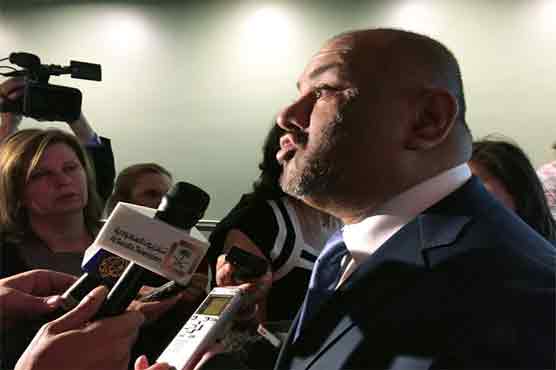
Speaking to reporters, Yemen s U.N. Ambassador Khaled Alyemany said both Hadi s side and the Houthis will attend the Geneva talks, adding that the government will be represented at a high level, perhaps by the vice president.
But a top Hadi aide, speaking on condition of anonymity because he was not authorized to talk to the media, said the government would not give up its condition for the talks.
The U.N. announcement came after the world body s new envoy to Yemen, Ismail Ould Cheikh Ahmed, held meetings with rival political players in Yemen earlier this month. The Houthis at the time expressed readiness to resume peace talks, insisting they take place in a "neutral" country.
Alyemany said the Houthis appear to have reached the moment of "wanting to talk," though they showed no signs of wanting to "give up what they consider their expansions on the ground."
Western countries accuse Shiite power Iran of backing the Houthis, something the Islamic Republic and the rebels deny. Both the Yemeni ambassador and the Saudi ambassador to the U.N., Abdallah Al-Moualimi, ruled out Iran s participation in Geneva.
"There is no place for Iran in the consultations in Geneva," Al-Moualimi told reporters. "They have not been playing a constructive role, and as such cannot be rewarded by having a seat at the table."
Speaking to reporters, U.N. deputy spokesman Farhan Haq said the format of the Geneva talks was still being worked out. He said Ahmed is expected to visit Tehran on Thursday for meetings with officials on Yemen, but did not give details.
Alyemany also said former President Ali Abdullah Saleh and Houthi figures who are on a U.N. sanctions list would not participate in the talks. The U.N. has not listed who has been invited.
The U.N. Security Council this year imposed an arms embargo on Houthi leaders and on Saleh, who stepped down in early 2012 as part of the U.N.-guided transition. The Security Council also has demanded the Houthis withdraw prior to any formal talks.
The rebels and their allies, Saleh loyalists, boycotted a gathering held in the Saudi capital, Riyadh, this week that was billed as a peace conference on Yemen.
Meanwhile, the Saudi-led coalition continued to pound the Houthis and their allies Wednesday in at least five northern provinces under rebel control, including Sanaa. In the western city of Ibb, warplanes struck a police commando camp run by Saleh s loyalists, killing at least 12 and wounding 17, officials said.
In the strategic port city of Aden, the rebels and their allies randomly shelled residential areas, killing one woman and wounding three.
The Houthis also continued to retaliate for the Saudi-led attacks by engaging in clashes in the border area of Jizan on Wednesday and killing one Saudi soldier, according to Saudi news site Sabq.
The Yemeni conflict has killed 1,820 people and wounded 7,330 since March 19, according to U.N. estimates, with nearly a half million people displaced through May 7.
Also Wednesday, international aid groups urged warring parties to agree to a ceasefire so that badly-needed humanitarian aid can be delivered, saying a five-day truce that was breached several times and expired this week was not enough.
"The amount of aid allowed in barely scratched the surface of the humanitarian catastrophe," said Grace Ommer, Oxfam s director for Yemen.
After a closed-door briefing by Ahmed, the Security Council expressed support for Ban s call for the resumption of humanitarian pauses.
But the Saudi ambassador to the U.N. told reporters that any further humanitarian pauses would be a military decision and will be based on the situation on the ground, specifically, "whether the Houthis are complying with such a pause."
Al-Moualimi said the previous pause "was misused in a very blatant way" by the Houthis and their allies, though he acknowledged that progress was made in delivering aid throughout Yemen during the break.
Also Wednesday, the U.N. said an Iranian ship with humanitarian supplies for Yemen is heading to Djibouti where the U.N. has its hub for the distribution of aid to the conflict-torn country. Deputy spokesman Farhan Haq said the U.N. received word from the Iranian government that the ship "will proceed to Djibouti" instead.
The ship, which had stirred controversy, was originally reported to be heading to Yemen s Hodeida port, where it was expected to arrive on Thursday.
Earlier Wednesday, Iran s Deputy Foreign Minister Hossein Amir Abdollahian told the semi-official ISNA news agency that the vessel Nejat, or Rescue, will travel to Yemen in "full coordination with the U.N."
The remarks come as an effort to deescalate the situation surrounding the ship, and reroute it to the Horn of Africa nation. Abdollahian said Iran will abide by the U.N. protocol, which requires aid to be routed through Djibouti.
Iran has backed Yemen s Shiite rebels in the conflict but denies arming them.
Yemen s conflict has also stranded thousands of Yemenis abroad, after the Saudi-led coalition imposed an air and sea blockade. On Wednesday, 352 Yemenis aboard two planes, from Egypt and India, landed in Sanaa, according to airport officials, who spoke on condition of anonymity because they were not authorized to talk to the media.