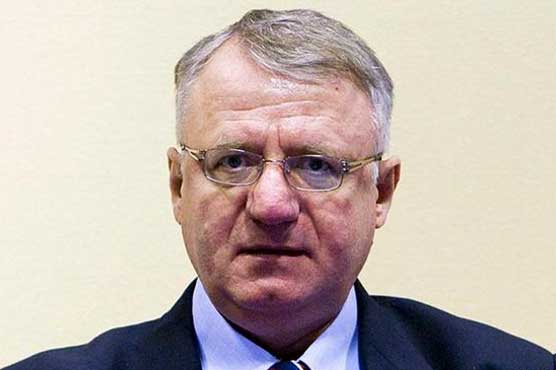
Summary Serbia now has the uncomfortable obligation of arresting the publicity-seeking Seselj
THE HAGUE (AFP) - The UN Yugoslav war crimes tribunal on Monday revoked the provisional release of ailing accused Serb leader Vojislav Seselj after he vowed not to to return to the court.
The International Criminal Tribunal for the former Yugoslavia (ICTY) "orders the trial chamber to immediately revoke Seselj s provisional release and order his return to the United Nations Detention Unit," in The Hague, court documents said.
The tribunal in November allowed Seselj to return home to Serbia for cancer treatment pending an ICTY verdict on alleged war crimes during the Balkan wars.
Since his release, 60-year-old Seselj has repeatedly lashed out at the tribunal, vowing not to return for his sentencing or to serve any time, as well as resuming his poisonous nationalist rhetoric.
Serbia now has the uncomfortable obligation of arresting the publicity-seeking Seselj and handing him over to ICTY authorities.
Seselj, accused of leading ethnic Serb volunteers in persecuting Croats, Muslims and other non-Serbs during the 1990s wars, underwent colon cancer surgery in 2013.
Serbia said it would allow the return of the ultra-nationalist firebrand, who was repeatedly found guilty of contempt during his trial.
Upon his return to Serbia after nearly 12 years in detention in The Hague, however, Seselj resumed his nationalist rhetoric by advocating creation of a "Greater Serbia" encompassing large parts of Croatia.
Seselj has pleaded not guilty to nine counts including murder, torture, cruel treatment and wanton destruction of villages.
Prosecutors said Seselj, a prominent radical politician, recruited and indoctrinated volunteers and paramilitaries, known as "Seselj s men" who committed atrocities during the Balkan conflicts.
The ultra-nationalist leader voluntarily surrendered to the ICTY in 2003 and went on trial four years later. He was in custody in the Netherlands.