Summary The IS offensive has sent more than 160,000 people fleeing across the border in a matter of days.
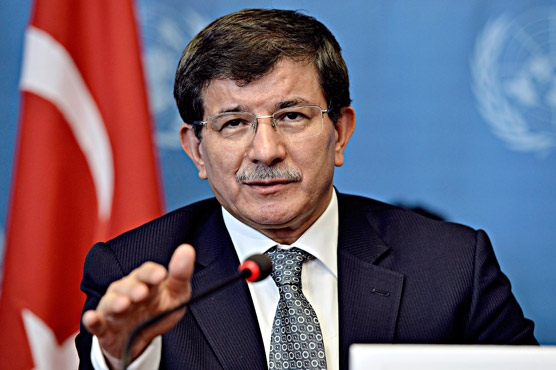
ISTANBUL (AFP) - Turkey will do whatever it can to prevent the Syrian Kurdish town of Kobane falling to jihadists, Prime Minister Ahmet Davutoglu said after the Turkish parliament gave the green light for military action.
Islamic State (IS) militants have now advanced to within a few kilometres from Kobane, known as Ain al-Arab in Arabic, which lies just across the Turkish border.
The IS offensive has sent more than 160,000 people, mainly ethnic Kurds, fleeing across the border in a matter of days, while Turkey already hosts hundreds of thousands of other refugees of the Syrian conflict.
"We do not want Kobane to fall. We opened our arms to our brothers from Kobane," Davutoglu said in an interview with A Haber-ATV television late Thursday.
"We will do whatever we can so that Kobane does not fall" to IS jihadists, he added, without giving specific details on the measures Turkey might take.
Officials have cautioned against expecting rapid military steps following parliament s approval and it remains uncertain if Turkish armed forces will be used against the militants.
Davutoglu said no decision had been taken on military action in a security meeting which came just ahead of Thursday s vote.
But he also said Turkey cannot "take a passive approach" and "let the events follow their natural course" which would result in a further IS advance and prompt an even larger refugee influx.
"There is a snake and we cannot say the snake that doesn t touch me can live a thousand years " said Davutoglu, using a Turkish idiom that means "out of sight, out of mind".
"No other country can affect the developments in Syria and Iraq (like Turkey). No other country will be affected like us either."
- Attempts to sabotage peace process -
Ankara remains reluctant to commit to a frontline role in the US-led campaign against IS, partly because it fears a military action would strengthen Syrian Kurds linked to Turkey s outlawed Kurdistan Workers Party (PKK), which has waged a 30-year insurgency for self-rule.
Kurds accuse Turkey of supporting IS militants in the fight against their Syrian brethren by blocking them from crossing the border.
Abdullah Ocalan, the jailed leader of the PKK, warned on Thursday that the fragile peace process between Ankara and the Kurdish rebels could collapse if IS militants seized Kobane.
"We will protect our Kurdish brothers from Kobane but there is no point in directly linking it to the peace process," Davutoglu said.
"Would it be possible for the Kurds of Kobane to come to Turkey without the peaceful atmosphere that the peace process made possible?" he added.
"Regional developments will not affect the peace process."
In a message for the upcoming Muslim festival of Eid al-Adha (Feast of the Sacrifice), President Recep Tayyip Erdogan also vowed to advance the peace process.
"The peace process, which will further strengthen our people s brotherhood and unity, is advancing despite attempts of sabotage," Erdogan said.
"But a powerful country seeks peace outside its borders too," he added, without specifically referring to the conflict in Syria.
Erdogan also sent a special message of support for soldiers guarding a sovereign Turkish exclave inside Syrian territory, saying "the Turkish army will be by your side without a moment s delay" if required.
The tomb of Suleyman Shah -- the grandfather of the founder of the Ottoman dynasty Osman I -- is considered Turkish territory under a 1920s treaty signed between the Turkish authorities and France.
The advance of IS militants in northern Syria towards the Turkish border stirred fears that the tomb might be their next target, with Turkish officials acknowledging that the jihadists had been advancing on the territory.
"Turkey will not refrain from defending every inch of our land and mobilising all its resources without hesitation," Erdogan said.