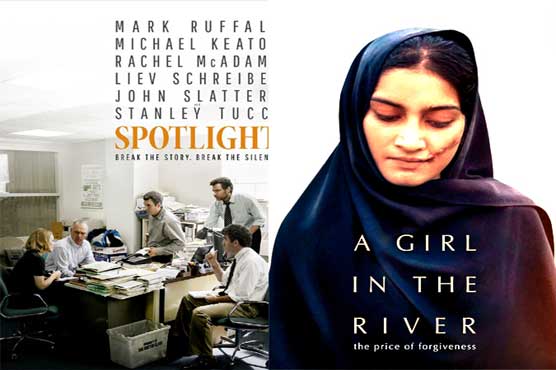
Summary "Spotlight" which brought to light a massive child sex abuse scandal won Oscar for "Best Picture.
Dunya News Report (Madiha Fareed)
On February 28th, the celebrated filmmaker Sharmeen Obaid Chinoy won her 2nd Oscar for her documentary film which highlights the menace of honor killings in Pakistan. “A Girl in the River: The Price of Forgiveness” follows the story of 18 years old Saba who survived an honor-killing attempt by her father and uncle. Ms. Chinoy had previously won an Oscar for her documentary film “The Saving Face”, which featured the lives of acid attack survivors.
Ms. Chinoy earned praises from all around the world for her brave effort and even the Prime Minister of Pakistan Nawaz Sharif promised to bring new legislation to criminalize honor-killings. However not everybody in the country felt the same, Ms. Chinoy came under fire for presenting a “negative image” of Pakistan. The “keyboard activists” in the country launched a campaign against her and even initiated a twitter hashtag #WeDisownSharmeen.
Interestingly, on the same Oscars night, the film “Spotlight” ended up winning the highest prize of the night, the award for Best Picture. Spotlight is based on a Pulitzer Prize winning investigative story by “Boston Globe” which brought to light a scandal of massive child sex abuse at the hands of priests of Roman Catholic Churches in Boston, Massachusetts. But amusingly we did not hear a similar outcry in USA for presenting a “dark” or “upsetting” image of the world’s super power. Nobody grumbled that the “positive aspects” about the country, such as United States is one of the most developed and technologically advanced nations in the world, should have been highlighted and appreciated instead.
Even more surprisingly, nobody complained that why a movie was not made about the Microsoft founder Bill Gates who is the biggest financer of the anti-polio campaigns all around the world or Mark Zuckerberg who has announced to give the 100 percent shares of his multi-billion conglomerate to charity.
Instead the effort was appreciated for using a powerful media platform to highlight the social evil that existed in the society.
But it was a whole different story in Pakistan; the “morally upright” and “pious” people of the pure land lashed out at Ms. Chinoy for highlighting only “bad” things about the country in her documentary films.
Sadly in Pakistan, it has become a “national attitude” to turn a blind eye to all the shameful veracities. We are not ready to accept the callous reality, and if somebody dare do that, the sanctity of the sacred land is suddenly endangered.
We try to gloss over the bigger problems by crying about the tiny “good things”. We are more than willing to blame Sharmeen Obaid but not ready to admit that a disgraceful quandary exists in the country and demands a solution. Sharmeen has done nothing but held up a mirror to Pakistani society and the ugly reflection is not easy to stomach for the “righteous” citizens.
But Pakistan has one of the best armies in the world? But we have a huge nuclear program? But Edhi is doing amazing work? These are our answers to the social ills and the “negativity” prevalent in the society.
What exactly Sharmeen Obaid should have made a documentary about? Hundreds of children dying of malnutrition in Thar? Hundreds abused in Kasur? More than half of the population lives below poverty line? Or that one out of every three Pakistanis do not have regular and assured access to food? The reality is harsh and gruesome and the one no one is willing to accept.
There are positives, though overwhelming, but very small in number. The fact of the matter is that the “bad” outnumbers the “good” with a huge margin.
We are no way in a position to make the claim that we are a nation of “many positives”. We fall short on every index on education, health and prosperity. Ironically our ministers are seen chanting “all is well” and blatantly claiming that “Pakistan is the next success story” whereas the ground realities are entirely contradictory. We like to live in a fantasy and keep ourselves content with the notion that we are the “special people” of the “pure land”.
To solve a problem, one first has to admit that a problem exists; hiding the face does not help and instead adds to the problem. We have to be open to debate the issues in order to find meaningful solutions to them.
Media is a powerful platform that can help bring to view the not so talked about and tabooed issues that are prevalent in our society. A recent example of which is the shockingfact that Pakistan did not have a law against child abuse until a week ago. The shameful truth of child abuse only came to light after the episode of colossal child abuse in Kasur appeared in the media last year and forced the lawmakers to admit that such horrendous crimes exist in the society and need legislation.
In a nutshell, we need to own our problems instead of whining about “negative imaging”. We as a nation need to grow up and acknowledge the fact that the problems, and a lot many of them, exist in our society in order to eradicate them instead of burying our heads in the sand.