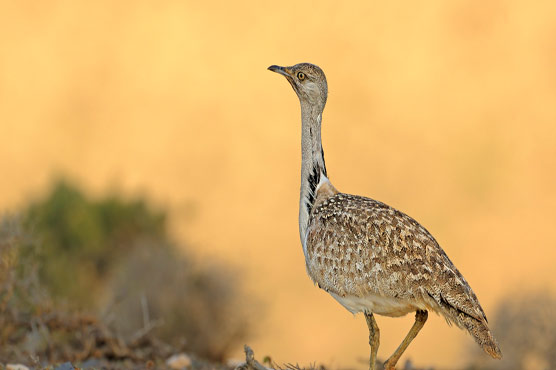
Summary Houbara bustard is a favorite of Arab hunters mainly because its meat is said to be an aphrodisiac.
Dunya News Report (Madiha Fareed)
ISLAMABAD- Denouncing its earlier decision, Supreme Court of Pakistan on Friday has lifted the ban on hunting of houbara bustards. Allowing the hunting under domestic laws, the verdict announced that some mistake had been made in the initial decision of Aug 19, 2015 which asked for a perpetual ban on the hunting of rare bird.
A five-member bench headed by Chief Justice Anwar Zaheer Jamali had concluded the hearing of review petition against houbra bustard hunting ban and reserved the verdict on the Jan 8, 2016. The decision did not come as unanimous; Justice Qazi Faiz Esa was not on board with other four judges of the apex court over lifting the ban. Other members of the bench included Justice Saqib Nisar, Justice Iqbal Hameed-ur-Rehman, and Justice Umar Atta Bandial.
On August 19, 2015, a three-member Supreme Court Bench headed by the then Chief Justice Jawad S. Khawaja ordered a complete ban on the hunting of houbara bustards and asked for cancelling of all the licenses and special permits issued in this regard. The court directed the provinces to make amendments in their respective wildlife laws to make them a with the International conventions like Convention on Migratory Species of Wild Animals (CMS) and Convention on International Trade in Endangered Species of Wild Flora and Fauna (CITES). The verdict was hailed as landmark by the environmental activists and the general public.
Federal Government filed a petition to review the decision which ordered a perpetual ban against houbara hunting. A total of 12 review and 2 constitutional petitions were filed before the Supreme Court by Federal and Provincial Governments to review the ban, 2 of which were withdrawn before the verdict was announced on Friday.
The government’s primary argument was that the ban is not consistent with the provincial laws that allow hunting under controlled conditions and that a complete ban is a barrier to investment in the downtrodden regions and may affect Pakistan’s friendly relations with brotherly Arab countries. Leading the arguments, Attorney General of Pakistan Salman Aslam Butt pleaded that court mends its decision and allow “sustainable hunting” of houbara bustards according to the domestic laws.
Farooq H. Naik, who was representing the Sindh Government, argued that it’s a conspiracy of India to deprive Pakistan of investment opportunities; Justice Saqib Nisar agreed to his comments and made the remarks that India is behind the lobby that wants a ban on houbara hunting.
After the 18th constitutional amendment the issue comes under the domain of provinces. The Pakistan Tehreek-e-Insaf led Khyber Pakhtunkhawa is the only province that is not a party against houbara hunting ban and remains the only province in the country where hunting of rare houbara bustards is still banned.
Houbara bustard is a migratory bird; a favorite of hunters from the Gulf States because its meat is said to be an aphrodisiac. In winters, a number of Arab Sheikhs come to Pakistan to hunt this rare bird which has a global population of a mere 0.1 million as estimated by International Union for Conservation of Nature (IUCN) and is on the red list of endangered species.
Those in favor of the ban criticized that the government’s only strategy to uplift the underprivileged regions is by giving free reign to Arab lords to kill a bird to extinction. The government has maintained that the Arab hunters bring investment in the downtrodden regions, and if a ban is imposed it would not be beneficial for the local community.
Environmental activists disparaged government’s logic that a ban on houbara hunting may affect Pakistan’s relations with Arab countries while criticizing the nature of these “brotherly” relations that are so tightly associated with killing of a bird. Conversationalists argued that people in power avenues just want to appease the Arab dignitaries by allowing hunting of the houbara bustards without caring about the disturbance it will cause in the eco system.