Summary "Protective Custody" must not be termed as arrest.
Dunya News Report (Madiha Fareed)
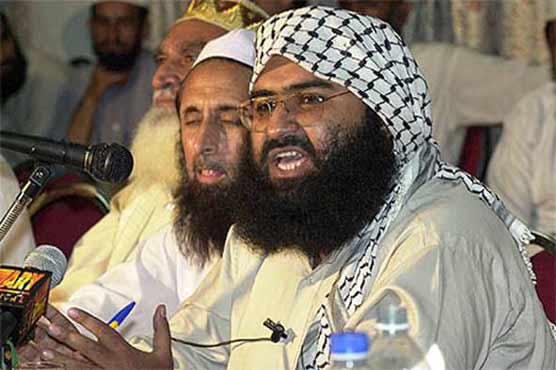
LAHORE: Punjab Law Minister Rana Sanaullah confirmed on Thursday that Jaish-e-Muhammad (JeM) Chief has been taken into “protective custody”. However he insisted that his custody must not be termed as “arrest” as JeM Chief will only face legal action if proved to be involved in Pathankot assault.
The news came after initial hesitation, when earlier in the day Foreign Office spokesman Qazi Khalil-ullah refused to attest to the news of Maulana Masood Azhar’s arrest. While talking to the reporters, he added that Pakistan is in regular contact with Indian authorities to finalize the schedule for talks. He denied knowledge of any meeting between the National Security Advisors of two countries in Paris.
The spokesman said that no date was decided for the Foreign Secretaries meeting, and that both countries are in contact with each other to decide upon a date for talks.
The same day Indian Foreign Office spokesperson Vikas Swarup commended the steps taken by Pakistan regarding Pathankot and confirmed that the talks will be rescheduled soon. He also welcomed and appreciated Pakistan’s offer to send an investigation team to India.
The speculations of JeM Chief’s arrest arose when a statement released from Prime Minister Office announced that “On the basis of initial investigations, several individuals belonging to Jaish-e-Muhammad (JeM) have been detained in Pakistan.” The official statement said that raids have been conducted to arrest the suspects and seize the offices of the banned organization that still might be operating.
The series of crackdown was carried out following a high-level meeting in Islamabad on Wednesday. Prime Minister of Pakistan Nawaz Sharif chaired a special meeting of senior cabinet members and top military officials to discuss security issues. The meeting was attended by Chief of Army Staff Gen. Raheel Sharif, ISI Chief Rizwan Akhtar, National Security Advisor General Nasser Khan Janjua, Interior Minister Chaudary Nisar Ali Khan, Finance Minister IShaq Dar, Chief Minister Punjab Shahbaz Sharif, Prime Minister Advisor on Foreign Affairs Sartaj Aziz, Foreign Secretary Mr. Aizaz Ahmed and other senior civil and military and police officials.
The statement issued after the meeting reiterated that Pakistan will not allow its territory to be used for acts of terrorism against any country and will offer all kinds of cooperation needed in investigations regarding Pathankot probe.
All this activity was a reaction to the attack on Indian Air Force Base in Pathankot, where six gunmen broke into the air base in India’s Punjab Province and engaged Indian forces in a heavy gunfire battle; the operation lasted four days killing all six attackers and seven Indian military personnel.
The responsibility of the attacks was initially claimed by United Jihad Council (UJC), a militant group based in Indian Kashmir. However, according to Indian media reports, the items recovered from the attackers were sufficient to link them to JeM.
The incident came roughly a week after Indian Prime Minister Narendra Modi’s surprise visit to Pakistan, and jeopardized the hardly restored dialogue process between two nuclear armed nations. It also question marked the fate of India-Pakistan Foreign Secretary level talks scheduled for mid-January. Last week India put the ball in Pakistan’s court, linking the FS-level talks to Islamabad’s “prompt and decisive” action in the Pathankot terror attack for which it has provided “actionable intelligence”.
Prime Minister Nawaz Sharif has been keen on improving relations with India ever since he took the office and has proved it yet again by responding quickly on Pathankot incident. However the Indian officials have still not confirmed whether the Foreign Secretary talks will take place as per scheduled or not. United States Secretary of State John Kerry telephoned Pakistani premier and emphasized that the dialogue process between two countries must not come to a halt.
Maulana Masood Azhar has been one of India’s most wanted terrorists; he was arrested in 1994 in Kashmir but was released in 1999 in exchange for 155 Indian passengers from a hijacked Air India flight IC-814. In 2001, he was accused of masterminding the attacks on Indian parliament that left nine people dead.
Jaish-e-Muhammad is a militant group whose primary motive is to separate Kashmir from India. It was formed in 2000 by Maulana Masood Azhar, shortly after his December 1999 release from prison. The group was formed after a split within Harkat-ul-Mujahideen (HUM). It has been banned in Pakistan since 2002, but has continued its operations under a new name “Khuddam-ul-Islam”.
The infamous organization has been suspected for killing American Journalist Daniel Pearl in Karachi. In 2009, police arrested four members of JeM for allegedly planning to plot a bomb in a New York City Synagogue as well as to shoot Stinger missiles at military aircraft in the United States.
Indian Authorities have long been adamant that Jaish-e-Muhammad is behind the insurgency in Indian –administered part of Kashmir and other parts of India. Indian officials also accuse Pakistani military for nurturing militant groups like JeM. However; COAS General Raheel Shareef’s attending the meeting that led to Masood Azhar’s arrest is deemed as a promising sign from Indian authorities.