Summary Tax collection, funding and accountability remain critical to better public services
ISLAMABAD (Web Desk) – Pakistan may need to redraw its administrative map and consider creating additional provinces as its population continues to grow, according to a new report published by the World Economic Forum (WEF) on October 9, 2026.
The report, What Pakistan Reveals About Administrative Reform for Fast-Growing Populations, examines how the country’s population has increased more than sevenfold since 1951, reaching approximately 260 million, while Pakistan continues to operate through the same four main provinces. It outlines several possible restructuring models, including creating 16 administrative units, establishing 23 to 25 units or developing more than 30 units based on existing civil divisions.
The analysis highlights the growing pressure on governments to provide education, healthcare, infrastructure and other essential services to increasingly large and diverse communities. Pakistan’s population could reach 265 million by 2030, making the question of administrative reform increasingly significant.
The report argues that administrative boundaries should evolve alongside demographic and economic realities. However, it cautions that creating additional provinces alone would not guarantee better public services without reliable funding, clearly defined responsibilities, stronger institutions and effective accountability mechanisms.
New provinces
The WEF report presents several scenarios for reorganising Pakistan’s administrative structure, with each offering a different balance between governance efficiency, public spending and the distance between citizens and decision-makers.
One option would divide each of the country’s four existing provinces into four, creating 16 first-tier administrative units. Under this model, the average population governed by each unit would fall from approximately 60 million to around 15 million.
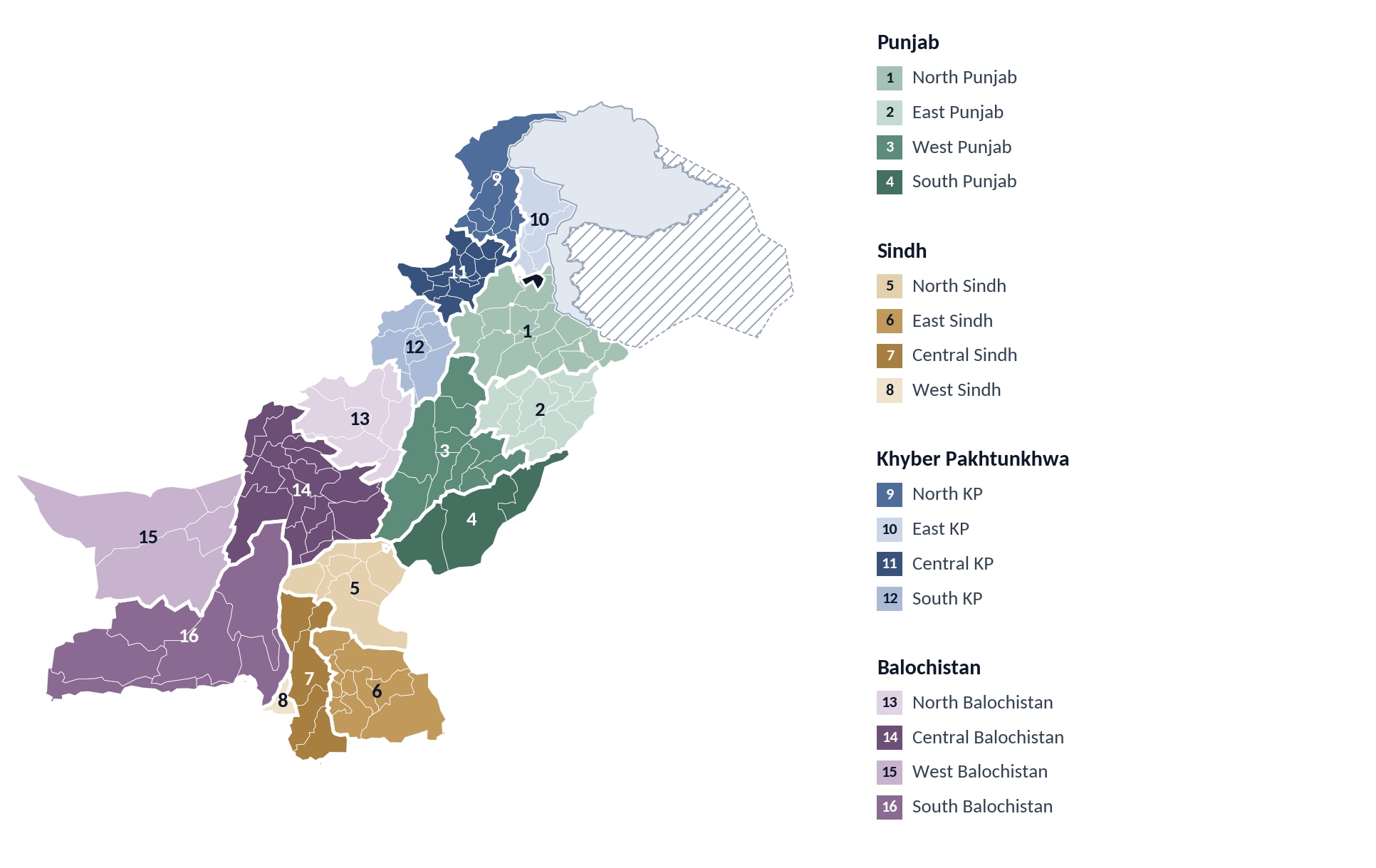
A more ambitious proposal would establish between 23 and 25 units, taking population balance or geographical coherence into account. Another approach would build on the existing civil divisions to create more than 30 administrative units, bringing their average populations closer to those of other large federations.
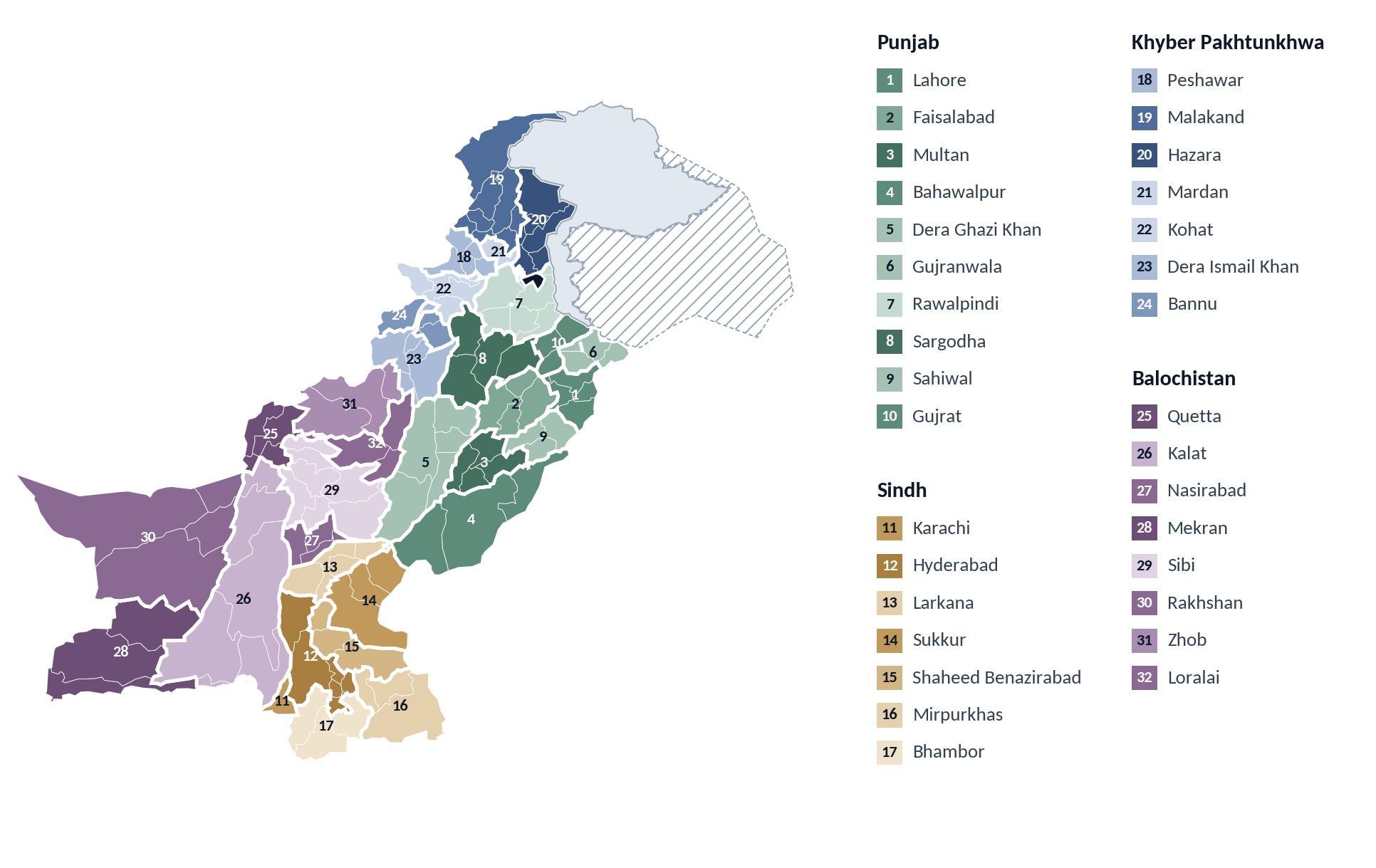
The report includes illustrative maps showing what a 16-unit structure and a more extensive arrangement of more than 20 units could look like.
Each model would involve different political, administrative and financial considerations. A smaller number of new provinces could be easier to legislate for and finance, while a larger number could bring administrative capitals, budgets and decision-making authority closer to communities.
However, establishing additional governments would also involve transition costs and require sufficient administrative capacity to manage public services, budgets and institutions.
The report does not prescribe one definitive provincial map for Pakistan. Instead, it frames restructuring as a choice between different governance models, with the appropriate approach depending on how effectively each arrangement matches administrative responsibilities with population needs and available resources.
Population imbalance
The scale of Pakistan’s population makes the debate particularly significant. Punjab alone has approximately 128 million residents, while Balochistan has fewer than 15 million, despite covering a much larger geographical area.
The differences are also visible within individual provinces. Lahore district has a population of around 13 million, compared with approximately 128,000 people in Harnai district in Balochistan.
These contrasting figures illustrate the challenge of designing provincial policies for districts with substantially different population sizes, economic conditions and service requirements.
Decisions made in provincial capitals must address the needs of densely populated urban centres as well as smaller, geographically dispersed communities. As administrative centres become more distant from peripheral districts, residents can find it harder to influence decisions affecting their daily lives.
The WEF report argues that administrative geography plays a significant role in how governments raise revenue, distribute public funds, plan infrastructure, respond to emergencies and evaluate performance.
When the boundaries and scale of administrative units no longer reflect demographic and economic realities, the distance between policymakers and communities can become a barrier to effective governance.
The proposed restructuring would seek to address this imbalance by bringing political authority and administrative resources closer to the people they serve.
Education gaps
Differences in public service delivery provide another indication of the challenges facing Pakistan’s existing administrative structure.
The Planning Commission’s District Education Performance Index found that none of the 134 assessed districts achieved the “very high” performance category.
National household survey reporting also indicates that 28% of children aged five to 16 are out of school. The reported provincial rates range from 21% in Punjab to 45% in Balochistan.
These figures underline the considerable variation in educational outcomes across the country. They also highlight the challenge of translating provincial policies and budgets into measurable improvements at district level.
The report links these disparities to gaps between decision-making and local needs, as well as between the allocation of public funds and the results achieved.
It argues that administrative reform should be assessed against improvements in public services rather than simply the number of provinces or administrative units created.
Smaller units could make it easier to identify local priorities and monitor spending, but this would depend on whether their governments have the authority, financial resources and institutional capacity to act on the information available to them.
Global lessons
Pakistan is not the only large country to have reconsidered its administrative boundaries as its population and economy have evolved.
Nigeria replaced its three-region structure at independence with 12 states in 1967, eventually expanding to 36 states by 1996. Indonesia increased its number of provinces from 27 in 1991 to 38 today.
Kenya took a different approach in 2013, replacing eight provinces with 47 elected county governments under a devolved system.
According to the WEF report, average first-tier populations in Indonesia, Nigeria and Brazil are around six million to eight million, considerably below Pakistan’s average of approximately 60 million across its four provinces.
Kenya offers a particularly relevant example because its administrative restructuring was accompanied by changes to political responsibilities and public financing.
Its counties became elected governments with constitutionally protected responsibilities and a formula-based share of national revenue. The allocation formula takes factors including population and poverty into account.
The report highlights this combination of administrative and fiscal reform as an important distinction. New boundaries were accompanied by institutions and funding arrangements intended to give local governments the means to carry out their responsibilities.
Lebanon provides a contrasting example. Despite having more than 1,000 municipalities, many remain too small and financially weak to deliver services effectively.
The comparison illustrates the risks of creating administrative units without ensuring that they can raise or receive sufficient funds, employ capable staff and fulfil their assigned responsibilities.
For Pakistan, the report suggests that any move towards additional provinces would need to be accompanied by reforms to public financing and institutional arrangements.
Funding challenge
The WEF report identifies provincial revenue collection as a major constraint on the effectiveness of Pakistan’s existing system and any future restructuring.
The 18th Constitutional Amendment and the 7th National Finance Commission Award were significant steps towards decentralisation. The amendment devolved major responsibilities, including health and education, to the provinces, while the NFC Award increased the provinces’ share of federal taxes from 47.5% to 57.5%.
However, greater responsibility for public services has not been matched by equally strong provincial revenue mobilisation.
Provincial taxes generated PKR 983 billion in the 2024-2025 fiscal year, equivalent to less than 0.9% of gross domestic product, according to the report.
Agriculture presents a particular challenge. The sector accounts for 24% of value added, yet agricultural income taxation has historically generated limited revenue relative to its economic contribution.
The International Monetary Fund estimates the effective tax rate on agriculture at just 0.3%. Agricultural income tax receipts have also remained below expectations despite increases in rates in 2025.
Provincial tax authorities have faced longstanding difficulties, including limited administrative capacity, weak enforcement and inadequate information for identifying taxable agricultural income.
Recent reforms seek to address some of these weaknesses, but their effectiveness will depend on improved data sharing with the Federal Board of Revenue, greater automation and stronger provincial enforcement capabilities.
The report argues that these shortcomings would need to be addressed alongside any administrative restructuring. Without stronger revenue systems and predictable transfers, newly created provinces could inherit the same financial constraints as existing governments.
Devolution reforms
The 18th Constitutional Amendment and the NFC Award marked major steps towards decentralisation, transferring responsibilities and resources from the federal government to the provinces. However, the WEF report argues that decision-making can still remain distant from communities within those provinces.
It says decentralisation must extend beyond provincial capitals, with administrative authority, funding and accountability reaching the districts and communities most affected by public policy.
Smaller administrative units could also create more opportunities for political and administrative leadership, allowing governments to develop policies around local economic strengths and specific regional needs.
This could be particularly relevant as Pakistan manages rapid urbanisation, climate-related emergencies, water stress and pressure to generate employment for its growing youth population.
However, the report cautions against treating fragmentation as an objective in itself. A larger number of governments could create additional layers of administration without improving outcomes if their responsibilities overlap or their budgets remain inadequate.
Effective reform would therefore require clear mandates, reliable transfers, comparable performance data and incentives for governments to mobilise their own revenue.
Greater fiscal proximity could also strengthen accountability by making it easier for citizens to connect the taxes they pay with the services they receive.
The report places particular emphasis on ensuring that funding arrangements and institutional responsibilities are designed alongside new boundaries, rather than introduced as separate measures after restructuring.
As Pakistan considers possible administrative changes, the central question is how to align the size of its governing units with the needs of its population while ensuring that every new administration has the resources and capacity to deliver essential services.