Summary PM Nawaz Sharif says Pakistan's nuclear materials, facilities and assets are safe and secure.
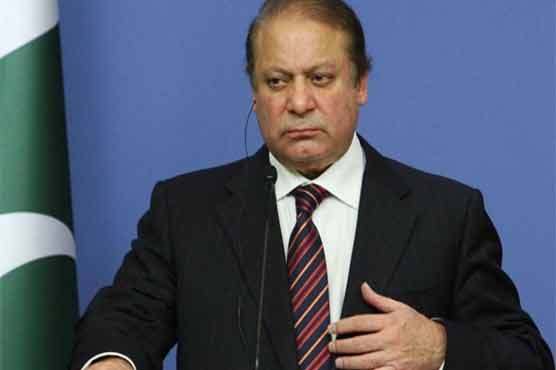
THE HAGUE (Web Desk) - Addressing the third Nuclear Security Summit here on Monday, Prime Minister Nawaz Sharif has said that Pakistan attaches highest importance to nuclear security as it is directly linked to our national security.
He said Pakistan is a responsible nuclear weapons state and it is pursuing a policy of nuclear restraint, as well as credible minimum deterrence.
Nawaz Sharif said Pakistan’s nuclear security is supported by five pillars–a strong command and control system led by the National Command Authority (NCA); an integrated intelligence system; a rigorous regulatory regime; a comprehensive export control regime; and active international cooperation.
He said Pakistan’s security regime covers physical protection, material control and accounting, border controls and radiological emergencies.
The PM said our nuclear materials, facilities and assets are safe and secure. Pakistan’s nuclear security regime is anchored in the principle of multi-layered defence for the entire spectrum – insider, outsider or cyber threat, he said.
Nawaz Sharif said Pakistan has established a Centre of Excellence that conducts intense specialized courses in nuclear security, physical protection and personnel reliability.
Pakistan is ready to share its best practices and training facilities with other interested states in the region and beyond, he added.
The PM said that Pakistan has also deployed radiation detection mechanisms at several exit and entry points to prevent illicit trafficking of radioactive and nuclear materials.
In the realm of international cooperation on nuclear security, Nawaz Sharif said that IAEA has an essential responsibility and a central role to play. Pakistan has been working productively with the IAEA to implement its Nuclear Security Action Plan.
He said Pakistan has been running a safe, secure and safeguarded civil nuclear programme for more than forty years. It has the expertise, manpower and infrastructure to produce civil nuclear energy.
The PM pointed out that energy deficit is one of the most serious crises facing Pakistan.
As the country revives its economy, it looks forward to international cooperation and assistance for nuclear energy under IAEA safeguards, he said.
Nawaz Sharif called for Pakistan’s inclusion in all international export control regimes, especially the Nuclear Suppliers Group. He said international treaties and forums should supplement national actions to fortify nuclear security.
He said Pakistan is a party to the Convention on the Physical Protection of Nuclear Material. It works closely with International Atomic Energy Agency (IAEA) to deal with safety and security of radioactive sources and illicit trafficking of nuclear materials.
It regularly submits reports to the UN Security Council 1540 Committee on the measure we take to exercise control over transfer of sensitive materials and technologies.
The PM announced that Pakistan is considering ratification of the 2005 Amendment to the Convention on the Physical Protection of Nuclear Material and is actively conducting a review to meet its various requirements.
Earlier, talking to media after his meeting with US Secretary of State John Kerry, Prime Minister Nawaz Sharif said that India was hesitating to resolve the Kashmir issue bilaterally.
He said if India was not willing to include third force in resolving the Kashmir issue then the US would have to play its role in bringing the situation normal in the region.
Nawaz stated that peace in Afghanistan was in the interest of Pakistan and the region. He said Pakistan wanted to talk to Afghan Peace Council to maintain peace in the region, adding that the improved relations between Pakistan and Afghanistan should not be derailed.
The Prime Minister termed the US policy of discontinuation of drone strikes in Pakistan appreciable and said it must be continued.
The PM also met with United States President Barrack Obama, Chinese President XI Jinping and Turkish President Abdullah Gul.
The informal meetings were held on the sidelines of the two-day Nuclear Security Summit here. The Prime Minister discussed with them matters of bilateral relations and mutual interests.
Later, Prime Minister Nawaz Sharif and French President Francois Hollande met on the sideline of the summit and exchanged views on all aspects of bilateral relations.