Summary Govt will investigate if Taliban support their claim with evidence, he said.
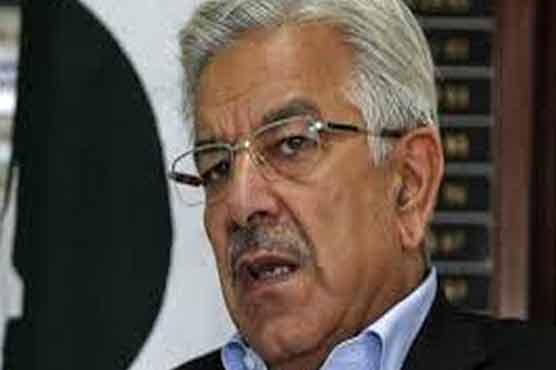
ISLAMABAD (Dunya News) – Federal Minister for Defense Khawaja Asif said on Sunday there are no women or children in custody of Pakistan security forces, rejecting Taliban claims of women and children being held by the forces, Dunya News reported.
Asif said he’s making this statement responsibly adding that if Taliban or their coordination committee should supply evidence if they have any and the government will investigate.
Taliban negotiation committee member Professor Ibrahim had asked the government to release imprisoned women and children as goodwill gesture.
It merits mentioning here that prior to Asif’s statement, Director General (DG) Inter Services Public Relations (ISPR) Major General Asim Bajwa had also rejected Taliban’s claim, maintaining that no women or children are being held in armed forces’ custody.
Military operation option still on table:
Earlier on Saturday, Khawaja Asif once again hinted of a possible military action against Taliban. He said that even though Taliban have distanced themselves from the recent terrorist attacks, they haven’t condemned them.
Defense minister, while talking to media, once again repeated the determination that government will have to consider the option of military operation if the negotiation process being held in the month of March fails, Dunya News reported.
It is pertinent to mention here that following a similar statement by Kh Asif a few days ago, Prime Minister Nawaz Sharif had stopped all ministers especially defense minister to issue any statement that could potentially harm or raise questions over the ongoing negotiation process. Yet Asif reinforced the idea of a possible military operation.
Answering a question, he reiterated that Taliban have distanced themselves from the recent terrorist attacks but haven’t condemned them.
In another question about former president Pervez Musharraf, he said that the law is not different for Musharraf and a common citizen adding that their government will prove that.
Insurgency, dialogue or operation:
Pakistan is facing almost a decade old insurgency at the hands of Taliban factions grouped under umbrella of Tehrik-e-Taliban. The new governing parties including Pakistan Muslim League Nawaz (PMLN) and Pakistan Tehrik-e-Insaf (PTI) had campaigned in elections in favour of resolving the years old conflict through dialogue.
The ruling party secured a vote of confidence in favour of dialogue through a session of All Parties Conference (APC) and to act on the recommendation upon willingness from Taliban, committees to represent both government and Taliban were formed and the process continued.
However, all negotiations stalled as a number of civilians and military personnel were brutalized whose responsibility was claimed by Taliban.
Following a number of air strikes by Pakistan military, Taliban agreed to a month-long ceasefire which was later reciprocated by the government.
Government also dissolved the existing committees emphasizing the need of moving forward the negotiations to next phase by restructuring the existing government committee to hold ‘direct talks’.