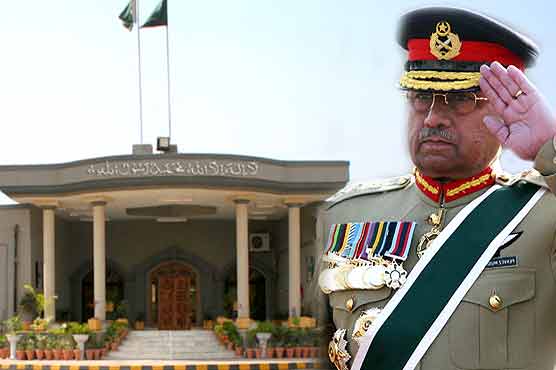
Summary The petition pleaded the court to bar special court from holding trial against Musharraf.
ISLAMABAD (Dunya News) – Former president Pervez Musharraf has challenged the treason trial in Islamabad High Court (IHC) on Saturday.
In his petition, the former military dictator stated that an individual trial against him cannot be held by the special court, stating that the November 3, 2007 step was taken with the support of all concerned people.
The writ petition was filed by advocate Khalid Ranjha on behalf of Pervez Musharraf.
The petition argued that the November 3 emergency was imposed with the backing of all concerned people in 2007. It wasn’t an individual act; therefore, holding a trial against him only was a violation of basic human rights.
The petition also stated that Musharraf imposed emergency as an army chief, arguing that a proceeding against a military official can only be held under army act.
The petition pleaded the court to bar special court from holding trial against Musharraf, adding that an inquiry under army act should be conducted if necessary.
Meanwhile, lawyers for Pakistan s former president Pervez Musharraf said a treason charge levied against him was politically motivated and that he would face a "show trial", urging the UN to intervene.
The legal team also called on the United States, Britain and Saudi Arabia to denounce Musharraf s trial to "repay their debt" for his support in the US-led "war on terror" in the wake of the September 11, 2001 attacks.
Musharraf overthrew the government of current Prime Minister Nawaz Sharif in a bloodless military coup in 1999 and ruled until 2008. His lawyers claim Sharif is using the treason case to get revenge.
The 70-year-old ex-military ruler, who is due to appear before a special court on December 24, is the first former military dictator in Pakistan s history to face trial for treason.
Musharraf s barrister Steven Kay told a press conference in London the hearing would be a "stage-managed show trial" with the judges picked by political opponents who are now in power.
"What we have here is a case that has started with the hand-picking of judges by the politicians -- or a politician, the prime minister -- in defiance of any person s right to a trial that is fair," Kay told reporters.
The trial is an "egregious example of political interference," he said.
Musharraf returned to Pakistan from self-imposed exile in March and was soon placed under house arrest.
The treason accusation relates to his decision in 2007 to impose emergency rule shortly before the Supreme Court was due to decide on the legality of his re-election as president a month earlier, while he was still army chief.
Kay said the judges selected for the trial would be unable to act impartially -- particularly since one of them, Faisal Arab, was sacked by Musharraf s government.
"If you ve been affected by what took place and then you judge it, there is a conflict of interest because you have an interest in getting retribution," Kay told reporters.
The legal team has written to United Nations human rights chief Navi Pillay and UN special rapporteurs calling for the international body to "urgently intervene and ensure that the former president is not subjected to politically motivated charges".
Lawyer Toby Cadman called on Musharraf s allies in the "war on terror" to support him, insisting this did not amount to interference in Pakistani justice.
"What is important is to ensure that voices of concern are expressed in terms of the charges which the former president faces, and recognition of his contribution to the war on terror ," Cadman said.
Musharraf has faced a range of criminal cases dating back to his rule since returning to Pakistan, including the murder of former prime minister Benazir Bhutto.
Speaking publicly Thursday for the first time since being placed under house arrest, he vowed to stay in Pakistan and face justice.
"I am pretty sure I did not commit any wrong thing," he told Pakistan s private television channel.
"Whatever I did was for the betterment and welfare of Pakistan and its people."