Summary PM advisor says Pakistan committed to promote common goals of peace and stability in region.
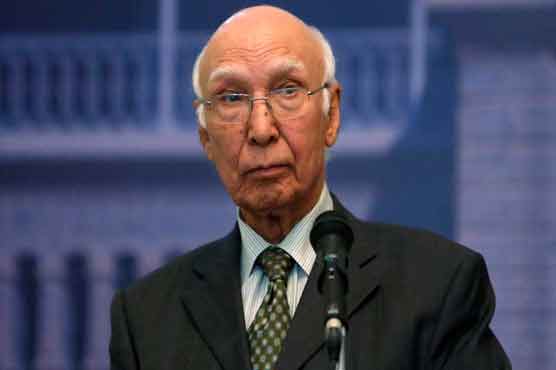
ISLAMABAD (Agencies) - Advisor to the Prime Minister on National Security & Foreign Affairs, Sartaj Aziz, Tuesday, stressed the importance of resuming the bilateral dialogue process between Pakistan and India.
While talking to Indian High Commissioner Dr TCA Raghavan he reiterated Prime Minister Nawaz Sharif’s commitment for normalizing relations with India,
Dr TCA Raghavan paid a courtesy call on Sartaj Aziz here and Advisor said that there had been great hope within the present government of picking up the threads from the Lahore Declaration of 1999 and embark upon a new phase of Pakistan-India relations
This was the High Commissioner’s first call on the Adviser since his arrival in Islamabad.
During the call, the Adviser stressed the importance of resuming the bilateral dialogue process. Reiterating Prime Minister Nawaz Sharif’s commitment for normalizing relations with India, the Adviser stated that there had been great hope within the present government of picking up the threads from the Lahore Declaration of 1999 and embarks upon a new phase of Pakistan-India relations.
The tension along the LoC seemed to have derailed this process which was unfortunate. He believed that the Indian media’s over-reaction to the LoC incident had also not helped.
He felt that both sides had to show maturity and move forward in a positive manner to resolve outstanding issues and put in a place a sustainable dialogue process.
High Commissioner Raghavan also viewed the LoC incident as a “setback” in the dialogue process.
Adding that while there was a feeling in India, also to continue to engage with Pakistan, incidents such as the recent one on the LoC raised doubts on Pakistan’s sincerity.
He felt that both countries needed to work towards forging a common policy on combating terrorism that would help in allaying many misperceptions that existed. He believed the upcoming visit of the Joint Commission on the Mumbai trials, to India would be helpful towards this end.
Adviser on Foreign Affairs and National Security Sartaj Aziz has said that Pakistan is committed to work with Afghanistan and regional and international partners to promote the common goals of peace, stability and prosperity in the region and beyond.
He was speaking on the topic “Afghanistan Reconnected: Linking Energy Supplier to Consumers in Asia” in a seminar here Tuesday.
He said that as a neighbouring and brotherly country, Afghanistan is close to us. Our relations are reinforced by strong bonds of a common history, religion and culture.
Secure energy supply and its link with economic development is self-evident. Prime Minister Nawaz Sharif has clearly underlined the government’s priority in terms of addressing our energy needs in the short and long term.
We are keen on working with Afghanistan as a conduit for energy supply.
Afghanistan has been facing conflict and instability for more than three decades. As a neighbouring country, Pakistan has consistently faced the fall out of this situation.
It goes without saying that a peaceful, stable and prosperous Afghanistan is in Pakistan’s vital national interest. We remain committed to supporting efforts for peace and reconciliation in Afghanistan in an inclusive, Afghan-owned and Afghan-led process.
For over three decades, Pakistan has been host to one of the largest refugee populations in the world, despite dwindling international support and in spite of our own economic difficulties.
About three million Afghan refugees still live in Pakistan, out of which about 1.6 million are registered. Just last month, we signed the Tripartite Agreement along with Afghanistan and UNHCR extending the stay of refugees till December 2015. We hope this time will be used to prepare for the return of the refugees to their homeland.
We continue to believe that their early, honourable and voluntary return, as well as sustainable reintegration, is possible if conducive conditions are created inside Afghanistan.
Successful security transition by the end of December 2014, and assumption of full responsibility for peace and stability by the Afghan National Security Force and Afghan National Army would help the country prepare a helpful environment for the pursuit and development of energy and connectivity projects.
Next year’s political transition, through successful conclusion of the Presidential and Provincial Council elections, would also be an important factor.
Afghanistan would require financial support, including investment in its infrastructure and institutional development, including health, education and human resource development.
Afghanistan would also benefit from technical support in terms of conceptualizing, initiating, operationalizing, and sustaining the different energy and connectivity projects. The involvement of external donors including the World Bank is welcome.
In conclusion, I would like to underline that sustainability of peace in the region can be ensured through economic development -- involving continued international engagement.
Peace and stability in Afghanistan are not only in Pakistan’s interest, these are also essential for the success of the reconciliation process in Afghanistan.
For its part, Pakistan will committed to work with Afghanistan and regional and international partners to promote the common goals of peace, stability and prosperity in the region and beyond.