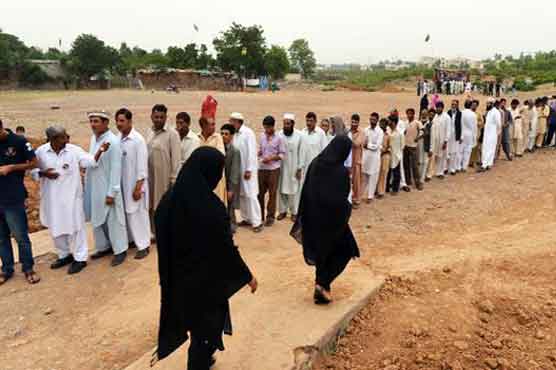
Summary The polling which started at 8 a.m. will continue uninterrupted till 5 p.m.
ISLAMABAD (Web Desk) - Defying the danger of militant attacks, Pakistanis streamed to the polls Saturday for a historic general election.
Despite the violence, many see the election — the country’s first transition between an elected government fulfilling its term to another — as a key step to solidify civilian rule for a country that has experienced three military coups.
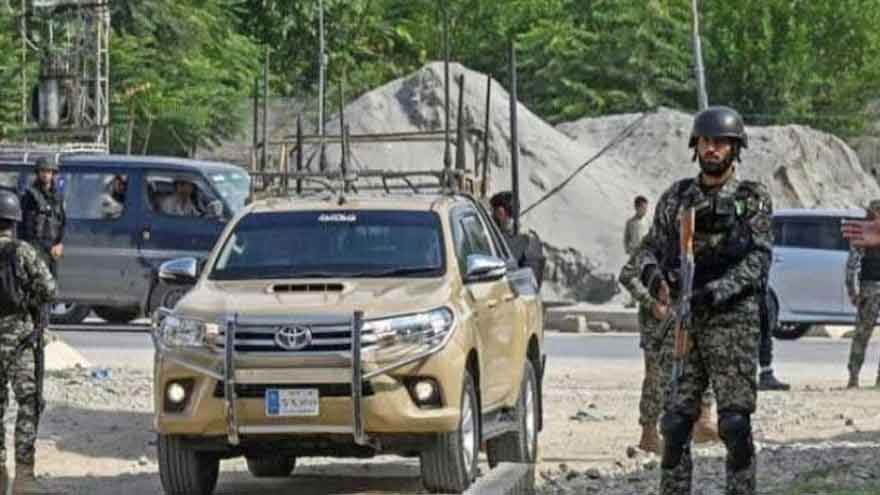
The government has deployed an estimated 600,000 security personnel across the country to protect polling sites and voters. But many Pakistanis still seemed determined to cast their ballots.
“Yes, there are fears. But what should we do? Either we sit in our house and let the terrorism go on, or we come out of our homes, cast our vote, and bring in a government that can solve this problem of terrorism,” said Ali Khan. He was waiting to vote in the city of Peshawar where one of the blasts took place Saturday.
The election is being watched closely by Washington since the US relies on Pakistan for help fighting militants and negotiating an end to the war in neighboring Afghanistan.
Former cricket star Imran Khan, who has almost mythical status in Pakistan, has challenged the dominance of the country’s two main political parties, making the outcome of the election very hard to call. He is facing off against the Pakistan Muslim League-N, headed by two-time former prime minister Nawaz Sharif and the Pakistan People’s Party, led by Bilawal Bhutto Zardari.
While Sharif has billed himself as the candidate of experience, Khan is trying to tap into the frustrations of millions of Pakistanis who want a change from the traditional politicians who have dominated Pakistani politics for years.
“I never voted for anyone in the past, but today my sons asked me to go to polling station, and I am here to vote,” said Mohammed Akbar, speaking from the northwestern city of Khar. “Imran Khan is promising to bring a good change, and we will support him.”
Khan’s mythical status grew even larger this week after he survived a horrific fall off a forklift during a campaign event in the eastern city of Lahore that sent him to the hospital with three broken vertebrae and a broken rib. He is not expected to vote Saturday because he can’t travel to his polling place.
Nobody is sure how effective he will be in translating his widespread popularity into votes, especially considering he boycotted the 2008 election and only got one seat in 2002. Turnout will be critical, especially among the youth. Almost half of Pakistan’s more than 80 million registered voters are under the age of 35, but young people have often stayed away from the polls in the past.
It is likely in the province of Punjab, Pakistan’s most populous, that this election will be decided. Sharif and Khan have been battling intensely for support of people across the province in a series of large rallies and campaign events.
On the campaign trail, Sharif pointed out how much more experience he has than Khan and touted key projects he completed while in office, including a highway between the capital Islamabad and his hometown of Lahore.
He’s also credited with refraining from attacking the outgoing government and allowing it to finish its full term as a way of strengthening civilian government control.
“It’s better to try a lesser evil instead of trying a novice,” said one voter in Lahore, Haji Mohammad Younus. “The lesser evils at least have the experience of governing. They might be corrupt but they have lately realized that they have to deliver if they want to survive.”
The outgoing Pakistan People’s Party is likely to fare poorly in this election. Voters are fed up with five years of power outages, rising inflation and militant attacks. The party, which rose to power in 2008 in part by widespread sympathy after the death of party leader Benazir Bhutto, has carried out what many called a lackluster campaign this election.
Their effort has been hampered by threats of Taliban violence and a lack of high-profile figures who could rally the party faithful. Benazir Bhutto’s son, Bilawal Bhutto Zardari, is officially the party chairman and had been expected to play a high-profile role in the election.