Summary The central bank doubles the key interest rate to 10.0 percent to halt a currency crisis.
ANKARA (AFP) - The Turkish lira jumped, but then shed half its gains, on Wednesday after the central bank ramped up interest rates, in an aggressive defence closely watched on emerging markets.
The central bank doubled a key interest rate to 10.0 percent to halt a currency crisis.
This was also a pre-emptive move against any tightening of US monetary policy later in the day, which could suck money out of emerging economies.
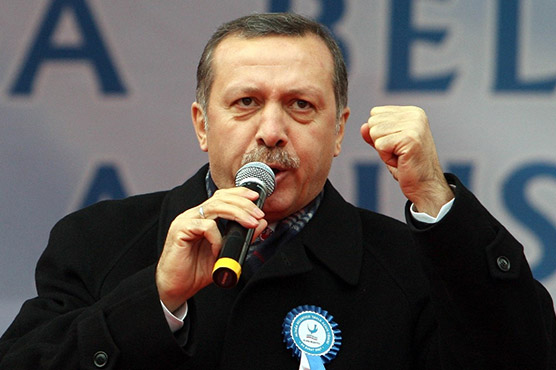
The lira leapt by about 3.0 percent overnight in response to the central bank s U turn, which defied Prime Minister Recep Tayyip Erdogan.
But during trading on Wednesday, the lira had lost half its gains. Before the decision it was at 2.25 to the dollar, it then shot up to 2.17 to the dollar, but later was down to 2.21.
But it was still well above the record low of 2.39 to the dollar it reached at one point on Monday.
The lira also slipped from its high point overnight to 3.0398 to the euro compared with 3.09 before the decision.
The Istanbul stock exchange gained 0.54 percent to 63,886.31 points.
Asian and European stocks rose in morning trading, with confidence generally over turmoil in emerging markets supported by the Turkish move which comes amid the most damaging political crisis in Turkey for a decade.
The change of policy sets the bank face-to-face with Erdogan who said only hours before that he did not want rates to rise.
Analysts say policymakers in emerging economies will closely watch the effects of the Turkish move, with the US Federal Reserve central bank due to say later in the day if it will reduce further its huge stimulus to the US economy.
They also said that the Turkish decision would help to restore credibility to the central bank, damaged by months of government pressure to avoid raising rates.
The bank increased its overnight lending rate to 12 percent from 7.75 percent, the overnight borrowing rate from 3.5 percent to 8.0 percent, and the pivotal one-week repo rate to 10.0 percent from 4.5 percent.
The currencies of emerging economies have taken a severe beating recently, due in part to US Federal Reserve policy reducing stimulus measures. This tends to suck cash out of emerging markets back to the United States.
The Turkish currency has lost about 10 percent since mid-December, when a corruption scandal roiling key Erdogan allies became public.
On Tuesday, the central bank of India announced a surprise decision to raise its key rate by a quarter of a point to 8.0 percent. Among other emerging countries in currency turmoil are Argentina, South Africa, and Russia.
The Fed tapering "hits countries that tend to fund their deficits with short term money flows like Turkey," said Kathleen Brooks, research director at Forex.com.
Brooks listed Turkey among those countries with shaky economic fundamentals, particularly current account deficits, along with India, Indonesia, South Africa and Thailand.
Deniz Cicek, economist at Finansbank in Turkey, hailed the central bank s decision as a "striking shift towards orthodoxy".
"In our view, a shift to a simpler framework, along with a message of commitment to sustain the tight monetary policy stance until there is a significant improvement in the inflation outlook also pleased the markets," he said.
But Erdogan s opposition to an increase hours before the decision had left some doubt as to whether decisive action would be taken.
The prime minister, who made a turnaround in Turkey s economic fortunes a keystone of his 11-year rule, said the bank would be responsible for any ensuing slowdown in growth.
His finance minister, Mehmet Simsek, declined to comment on the central bank s decision, because he said the bank s credibility was "critical".
"If they made such a decision, I am sure it is the best one," he told Turkish television.
"The central bank is doing well in a climate of global problems," he said, adding that "the central bank decision has eliminated investors concerns to a significant extent".
Erdogan s government wants rates held down to sustain growth ahead of an election cycle beginning with March local polls.
Until now, the bank has avoided a sharp rise in the base rate, using a big increase in the overnight rate and intervening heavily on the foreign exchange market.
Some analysts estimated in July last year, when the bank began intervention, that it had about $46 billion dollars (34 billion euros) available but since then it has spent heavily, using up to $4 billion in the last few days alone.