Summary China opens a joint military training base in Laos at a former CIA airfield, raising regional security questions near Thailand's border.
China’s military has opened a new outpost on a site in northwestern Laos which was once a Vietnam-era CIA airfield.
The base, about 40 miles north of the capital Vientiane and just 25 miles from the nearest border with Thailand, comprises the China-Laos Joint Support and Training Center at Ban Keun Airport, and the China-Laos Friendship Aviation Academy. It began operations on September 29, according to an announcement from China’s Defense Ministry.
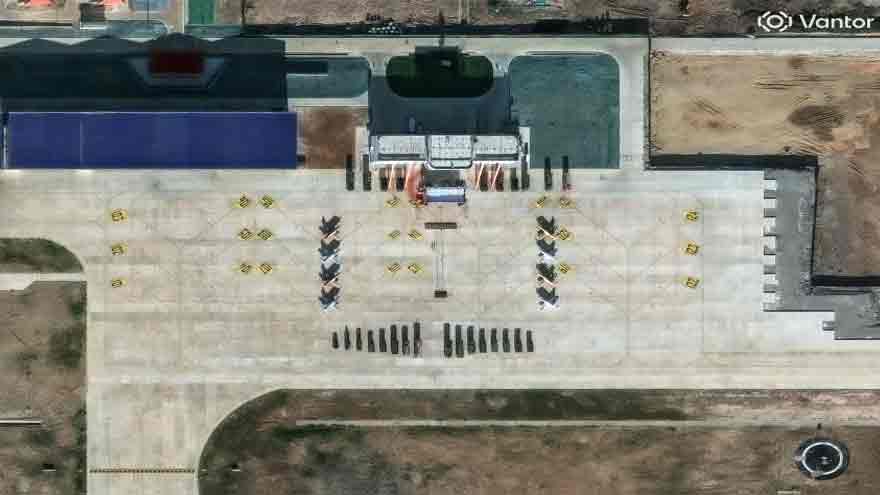
Photos obtained by CNN from satellite imagery and intelligence platform Vantor show a 6,500-foot-long (2,000-meter-long) runway, taxiway and parking apron for 22 aircraft have been completed at the base since December.
The facilities are “designed to help Laos strengthen the training and development of its air force pilots and will be jointly maintained by both sides,” the Defense Ministry statement said.
Eight aircraft – possibly Hongdu JL-8 jets, a two-seat training and light-attack aircraft – are visible in the satellite photos.
The facilities are “not directed against any third party and are conducive to further strengthening practical cooperation between the two militaries and maintaining regional peace and stability,” the ministry said.
To date, China has only one official overseas base, an installation in Djibouti, northeast Africa, that opened in 2017.
It also funded a major expansion of Cambodia’s Ream Naval Base on the Gulf of Thailand, which it operates jointly with the Cambodian military.
A new pier there, large enough to handle the PLA Navy’s aircraft carriers, has raised concerns about Beijing’s intentions in the region. But Cambodia’s government maintains Ream is open to others, including the US Navy, which had a littoral combat ship call there in January.
The Ban Keun base in Laos used to be used by the CIA-operated Air America during the Vietnam War, as a logistics and support hub for secret operations in the region.
But China’s move there – while symbolic – doesn’t signal any major shift in the US-China power balance, analysts said.
Drew Thompson, a senior fellow at the S. Rajaratnam School of International Studies in Singapore, said Thursday it’s hard to see any threat to US forces in the region from the base.
“This runway is not a dagger pointed at the heart of anything,” Thompson said.
“I struggle to think of a scenario where (China would) want to generate aircraft sorties from there,” he said, noting its location near Thailand, a major non-NATO ally of the US.
Rachel Vandenbrink, a senior analyst at the Australian Strategic Policy Institute, told Reuters that China’s selection of Ban Keun “is likely more about a target of opportunity than filling an obvious operational need.”
“Laos does have some geostrategic value as an accessible foothold in mainland Southeast Asia, given its shared border with China and infrastructure links, including (its) railway,” Vandenbrink told the news agency.