Summary Taiwanese troops drilled to defend the Danjiang Bridge near Taipei during Han Kuang exercises, testing readiness against a potential Chinese invasion of the island.
NEW TAIPEI, Taiwan (Reuters) - Taiwanese troops on Thursday practiced defending a bridge at a critical chokepoint that could give Chinese forces a shortcut to take the capital Taipei, as annual war games entered their second day testing the island's ability to repel an attack.
Taiwan kicked off the Han Kuang exercises on Wednesday. Lasting 10 days, the drills focus on Taiwan's combat readiness against a potential attack from China, which regards the democratically-ruled island as its own territory and has vowed to bring it under its control, by force if necessary.
The Danjiang Bridge, which opened earlier this year, crosses the entrance to the Tamsui River which leads to Taipei though it is located in the capital's neighbouring city of New Taipei.
Soldiers erected barriers, barbed wire defences and sandbag positions during the late night exercise on what is the world's longest single-mast asymmetric cable-stayed bridge.
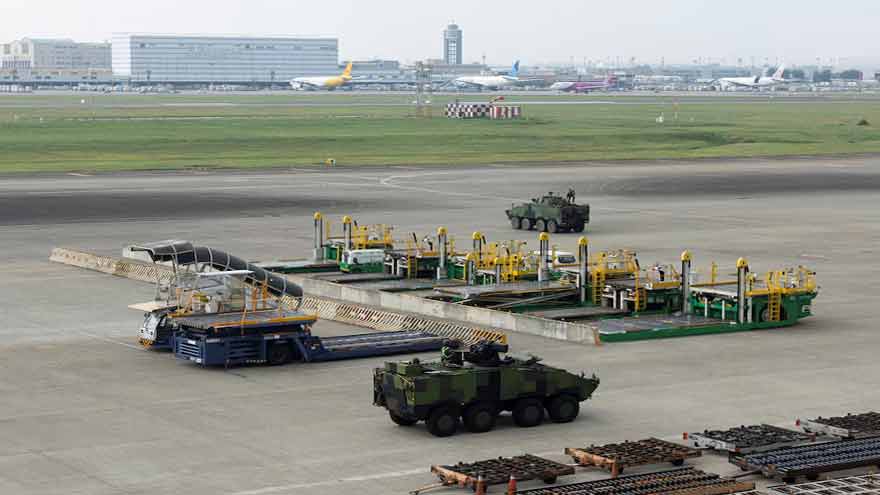
Military vehicles and flatbed trucks drove onto the bridge as soldiers unrolled coils of barbed wire, unloaded sandbags and set up defensive positions.
Cyclists and pedestrians continued to pass through the unblocked part of the bridge while troops worked along the span.
Chieh Chung, a researcher at Taiwan's Institute for National Defence and Security Research, who was observing the drills, said protecting the bridge would be crucial in time of war.
If an invading force were to seize and keep the Danjiang Bridge open, it could quickly move troops and supplies across the river, effectively entering the outer perimeter of Taipei from beachheads along Taiwan's northern coast most suitable for a large-scale amphibious landing, he told Reuters.
"If the Danjiang Bridge remains open, its main forces could quickly cross it to reach the northern bank of the Tamsui River and then move into Taipei itself," he said.
"Therefore, if the communist army were to rapidly seize the Danjiang Bridge during wartime and keep it open, it would be able to move large numbers of troops and supplies quickly from its landing base on the southern bank of the Tamsui River to the northern bank."
Chieh said while the exercise did not simulate a full closure of the bridge, it did allow the military to gather data on how quickly engineers could deploy obstacles and what resources would be required to seal the crossing in wartime.
Taiwan's government rejects Beijing's sovereignty claims.