Summary Replanting is a daunting task after Ditwah flooded crops across 535,000 hectares
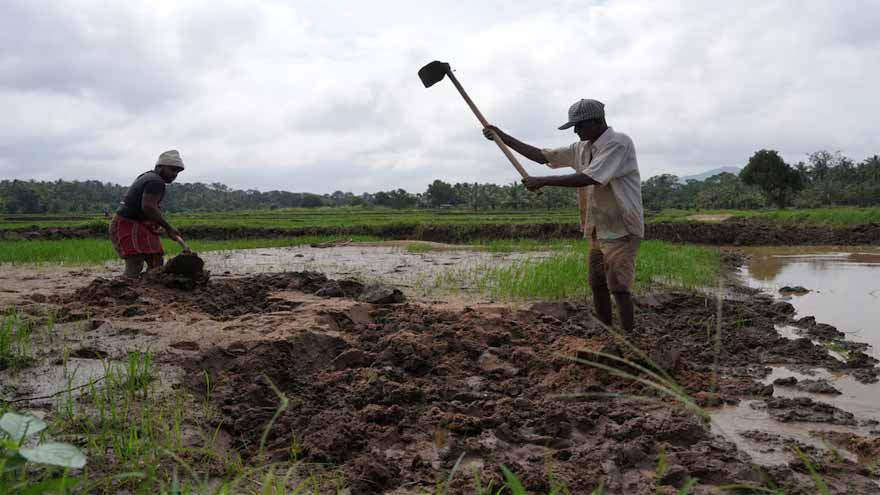
PALLEPOLA (Reuters) - Mud and sand have swamped a rice crop across Kalanchi Dewage Risman's two-acre (0.8-hectare) tract that had just been starting to show green shoots when Cyclone Ditwah ripped through Sri Lanka.
"I have to clear out the mud, level out the field, and then plant again," said Risman, 55, who earns his livelihood from rice farming, along with his wife and two sons, but faces the prospect of going even deeper into debt to make a recovery.
"It's already mid-December and rice planted this late won't provide a good harvest."
Replanting is a daunting task after Ditwah flooded crops across 535,000 hectares (1.3 million acres), while government data shows more than 120,000 hectares (297,000 acres) have been completely washed away or buried under mud and sand.
FARMLAND DEVASTATED BY DITWAH
Ditwah hit key growing regions for rice, vegetables and maize farmed by nearly 1.8 million families when it scythed through the island of 22 million in November, killing 643 people and sending more than 70,000 into relief centres.
Just a fortnight before, nearly 800,000 farmers had cultivated 563,950 hectares (1.4 million acres) of paddy in the main growing season from November to February, United Nations estimates show.
But floods, prolonged inundation, and winds have caused severe damage to about 95,799 hectares (237,000 acres) of other field crops, while 13,463 hectares (33,300 acres) of maize, pulses, bananas, and vegetables have also suffered.
Torrential rain and floods tore up 483 dams and 1,936 canals to swathe rice fields in central Sri Lanka in mud, the agriculture ministry's initial estimates showed.
Rice and vegetable farming supports about 300 families in the region and many are pooling resources to salvage at least some fields, said six farmers who spoke to Reuters.
LOOKING FOR A HOME TO RENT
Many have yet to receive any of the promised government compensation of 150,000 rupees ($485) for fields that have been completely destroyed and they worry the money will fall short.
Niluka Yaparatne, 48, is looking for a home to rent after a landslide that killed seven neighbours smashed into her home, nestled on a hillside. She said her family had taken a 2 million rupee loan to build the home.
"We built it bit by bit and finally completed it in 2022," said Yaparatne, now living with a relative after she and her disabled husband, Pattini Gedara Nihal, 51, fled with their three children in a three-wheeler in the middle of the night.
"We need to find a home near to the children's school but rent prices are higher now."
Torrential rain brought by the cyclone swamped the paddy field farmed by her husband with mud and sand, while authorities have declared the entire block of more than 50 homes landslide-prone, and evacuated families to nearby relief centres.
Food inflation could double in the short term from 3% in November, said Raynal Wickremeratne, research co-head at Softlogic Stockbrokers.
"We would need to import a quantity of rice to manage this season," he added. "Farmers need state support. It's not just a loss of crop, it's also the cost of rebuilding the fields and the costs of replanting and fertiliser."
COMPENSATION TO BE HANDED OUT THIS WEEK
More than 15 billion rupees earmarked for compensation will be distributed from this week, Agriculture Secretary D. P. Wickramasinghe told Reuters, ruling out the prospect of immediate rice imports.
Large swathes of the rice crop can be salvaged if replanting and irrigation repairs are carried out swiftly, he said.
"We are encouraging farmers to replant by end December," he added. "Some fields will recover from floods and we expect rice production to be about 3.5 million metric tons, which should be sufficient."
That is scant consolation for farmers like Risman.
"My hope is that we can at least plant for the next season in May," he said, standing beside his field under bleak skies that threatened more rain.
Risman is staring at the need to shell out funds for heavy machinery, seed paddy and fertiliser, amounting to 175,000 rupees ($566) to ensure a partial recovery, while repaying a loan of 50,000 rupees ($162) he took for this season.
"I don't understand where to even start."