Summary Mixed martial arts made its Asian Games debut with modified safety rules, as organisers seek to make the sport more suitable for potential Olympic inclusion.
NAGOYA, Japan (Reuters) - With no cage, no elbows and no appetite for blood on the mat, the Asian Games' mixed martial arts competition is not quite the visceral experience of a UFC fight night.
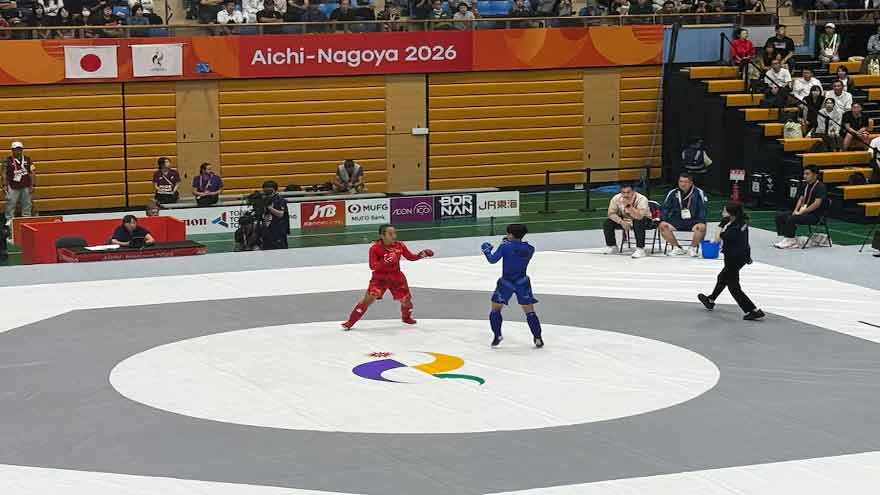
The athletes battle in traditional martial arts uniforms, wear shin guards for protection and dropping knees onto prone opponents is very much out of bounds.
The only octagon at the Nagoya City Inae Sports Centre is a grey one marked on the open mat.
The competition's organisers know the modifications may not be to the liking of hard-core fans of a sport once dubbed "human cockfighting" but they are part of an attempt to make it more palatable for a longer-term tilt at Olympic inclusion.
"It's a sport, a rule-set that we believe is more suitable for the Olympic programme," Galastein Tan, director general of the Federation of International Mixed Martial Arts (FIMMA), told Reuters.
"A rule-set that we think is very athlete safety-centric."
HEAVY TAKEDOWN
Modifications aside, the fighting at the sport's Asian Games debut remains intense and bruising.
South Korea's Lee Bo-mi was in tears and clutching her shoulder after a heavy takedown from Bahrain's Russian-born fighter Diana Pogosian in the women's 54kg semi-final
Off the mat, there is a bigger fight in the background as the sport's rival governing bodies grapple for influence and global supremacy.
FIMMA, established last year, was born out of the Asian Mixed Martial Arts Association set up by Chinese billionaire Gordon Tang.
With Tang a vice-president of the Olympic Council of Asia, FIMMA's brand of MMA was endorsed for Nagoya and will be retained on the programme of sports for subsequent Asian Games, FIMMA officials told Reuters.
Getting MMA to the Olympics will be a far more complex journey.
FIMMA has another rival shooting for Olympic recognition in the Global Association of Mixed Martial Arts (GAMMA), which describes itself as the sport's international federation and organises its own championships.
"When you talk about governing bodies, anybody can set up an association or international association," said Tan.
"The ultimate one is who gets the recognition by the International Olympic Committee."
There were banks of empty seats at the venue and no visible sponsor logos on day two of the Asian Games competition.
But FIMMA is hopeful IOC officials will take notice of the tournament and see the potential of including a sport with a massive global following on the Olympic programme.
With no universally accepted rule-set for the sport, it may be some time before MMA can be looked at as a serious option, though.
Until then, FIMMA will look to build momentum and influence by staging more regional and continental competitions, pushing a format they say is more accessible than cage fighting.
"There is always a judo mat or a karate mat you can use -- it's more easy for training and to set up competition," said FIMMA Executive Vice-President Alexander Engelhardt.