
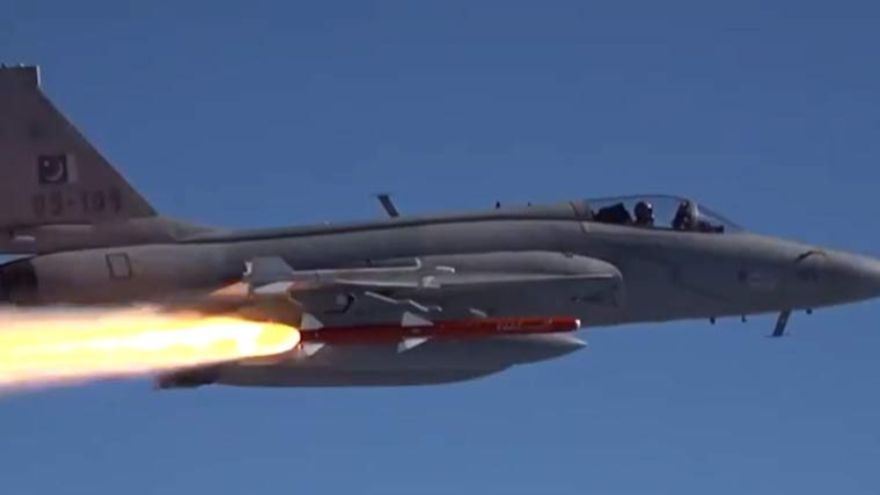
Summary Pakistan successfully tests its first indigenous Fa’az air-to-air missile, featuring advanced terminal guidance technology to strengthen PAF capabilities.
ISLAMABAD (Dunya News) – Pakistan has successfully conducted the flight test of its first indigenously developed Fa’az air-to-air missile, marking a significant breakthrough in the country's aerospace and defence technology.
The development is expected to strengthen the operational capabilities of the Pakistan Air Force (PAF) and demonstrate the growing technical expertise of the country's defence industry.
The military's media wing, Inter-Services Public Relations (ISPR), announced the successful test on Tuesday, describing it as another important milestone in advancing Pakistan's indigenous aerospace and defence capabilities.
The Fa’az missile has been equipped with a state-of-the-art terminal guidance system, enabling it to engage enemy aerial targets at longer ranges. According to the ISPR, the new weapon system will significantly enhance the operational flexibility of the Pakistan Air Force while further strengthening the country's overall defence posture.
The successful flight test highlights Pakistan's progress in developing sophisticated defence systems through domestic research, engineering and technological innovation.
The missile's terminal guidance system is a key feature, allowing it to guide itself towards an aerial target during the final stage of its flight. This capability is particularly important in air-to-air engagements, where the ability to accurately track and intercept moving targets plays a critical role.
The ISPR, however, did not disclose the missile's maximum operational range, speed, dimensions or other technical specifications. Details about its potential induction into operational service were also not provided.
Pakistan has conducted successful flight test of first indigenously developed Fa'az air-to-air missile. @OfficialDGISPR @PakistanFauj @DGPR_PAF @GovtofPakistan #RadioPakistan #News #AirToAirMissile #ISPR https://t.co/mWUNdyupy3 https://t.co/Vr1DYyCiQv
— Radio Pakistan (@RadioPakistan) November 3, 2026
The military's announcement focused on its longer-range engagement capability and advanced guidance technology, without specifying the precise distances at which the missile can engage targets.
The successful test has also drawn attention to Pakistan's growing efforts to develop advanced aerial combat systems alongside its fighter aircraft programme.
The JF-17 Thunder, jointly developed by Pakistan and China, remains a central component of the Pakistan Air Force's modernisation programme. However, the ISPR's announcement did not identify the aircraft used to launch the Fa’az missile during Tuesday's test.
The military described the achievement as evidence of the technical maturity, innovation and self-reliance developed within Pakistan's defence industry.
The launch was witnessed by senior officers of the Pakistan Armed Forces, alongside scientists and engineers who played a key role in developing the advanced weapon system.
President Asif Ali Zardari, Prime Minister Shehbaz Sharif, Chief of Army Staff and Chief of Defence Forces Field Marshal Syed Asim Munir, and the services chiefs congratulated the scientists and engineers on the successful test.
The leadership praised their technical expertise, dedication and contribution to strengthening Pakistan's indigenous defence capabilities.
The Fa’az test follows other recent missile-related developments in Pakistan, including the successful test of the extended-range Fatah-4 ground-launched cruise missile on October 6 and the Fatah-2 Extended Range hypersonic ballistic missile on October 13, both announced by the ISPR.
The latest achievement adds an air-to-air weapon system to the country's recent series of indigenous defence technology developments, highlighting continued efforts to expand domestic capabilities across different areas of military aviation and missile technology.