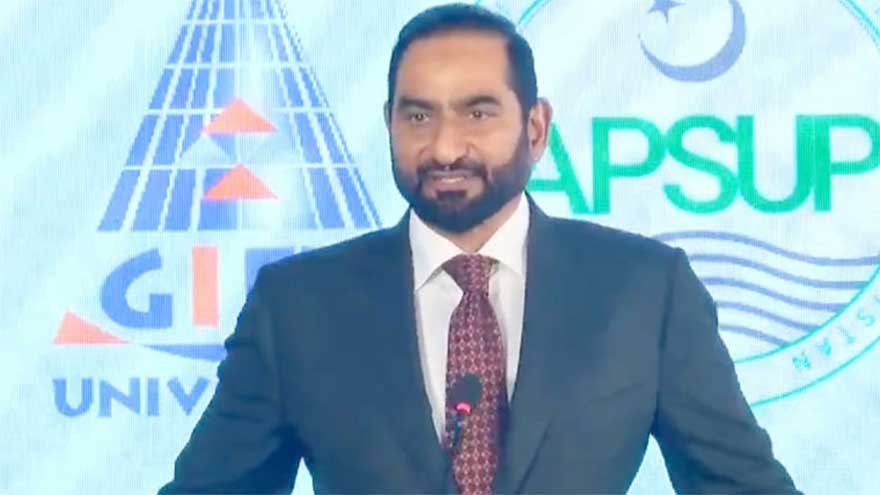
Summary He was speaking at Gift University under APSUP awareness campaign on “Pakistan 2030: Challenges, Opportunities, and New Pathways"
GUJRANWALA (Dunya News) – Chairman of Dunya Media Group, Mian Aamer Mahmood, said on Thursday that larger provinces were an obstacle to development of Pakistan.
While speaking at Gift University under APSUP awareness campaign on “Pakistan 2030: Challenges, Opportunities, and New Pathways,” Mian Aamer said it has been 79 years since Pakistan was created, yet governance in this country has still not improved.
He said that the potential that exists in this country has not been utilized to this day.
He said that 65% of Pakistan’s population consists of youth, yet only one percent of them are able to reach universities.
Mian Amer said that even before and after the 1973 Constitution, Pakistan had only four provinces, and the country continued to be run under different governance systems. The provinces are lopsided; Punjab province makes up 52% of Pakistan’s population. We are the only country in the world whose one federating unit is larger than all the others.
He said that provinces of such size are an obstacle to development. In education, health, infrastructure, and justice, we rank among the lowest countries in the world. A World Bank group conducted a study on Pakistan and published a report about what the country would look like when it reaches 100 years. The World Bank report explained the areas in which Pakistan would need to improve.
Balochistan, in terms of area, makes up half of Pakistan, and even today establishing law and order there is becoming difficult. Aside from the capital cities, we have not been able to develop any other city to a good standard, he added.
The chairman of Dunya Media Group said that Faisalabad is Pakistan’s third-largest city, yet it has no good hospital, university, school, or college. The people of Faisalabad must travel to Lahore for every major need.
He stated that Gujranwala is Pakistan’s industrial hub; we refer to Gujranwala, Sialkot, and Wazirabad together as the “Golden Triangle.” Compared to Lahore, Gujranwala also receives insufficient facilities from the government.
He said that the Punjab government sits in Lahore and tries to run 60,000 schools across the province. When Shehbaz Sharif was the Chief Minister of Punjab, he had to call the army to count the schools. How can a department run schools when it cannot even count them?
He added that similarly, Sindh has 40,000 schools that the government attempts to run from Karachi. The situation of education in Khyber Pakhtunkhwa and Balochistan is the same. The Punjab government spends 4,400 rupees per month on each student in public schools — this is not a small amount, nor is there any shortage of resources.
Mian Amar said that the Punjab government spends Rs6 million per year on each bed in public sector hospitals; there is no shortage of resources there either. Punjab is a province with a population of 130 million; only 12 countries in the world are larger than it. Similarly, 172 countries in the world are smaller than Balochistan in area. Among the world’s 10 most populous countries, Pakistan ranks fifth.
He stated that China and India are among the world’s most populous countries. China has 31 provinces. India gained independence at the same time as Pakistan; at the time of independence, India had 9 provinces, and today it has 39. Whenever India feels that governance is not functioning properly, it creates a new province. Every 5 to 10 years, one or two new provinces are formed in India.
He explained that the United States has 50 states. Indonesia, a country with a population of 270 million, has 34 provinces. Pakistan ranks fifth in population, yet it has only four provinces. Nigeria is sixth in population and has 27 provinces. These countries have reduced the size of their administrative units over time.
He said that Brazil has 36 provinces, while Russia has 46 provinces, 22 republics, and nine territories. Countries adjust their provinces according to their needs and population. Unfortunately, we have turned provinces into a source of ethnic division. When leadership fails to deliver, it resorts to ethnic sentiment.
Mian Amer said that in the Sustainable Development Goals (SDGs), a survey of 167 countries was conducted, and we ranked 140th. In the Human Development Index, out of 193 countries, we are ranked 168th. In the Rule of Law Index, out of 142 countries, our ranking is 129. In the Global Hunger Index survey of 127 countries, we stand at 109th.
He said that we are unable to provide food to our own people. Forty-four percent of our children suffer from stunting; 44% of our children do not receive a balanced diet. These 44% of children will not be able to perform any productive work; their bodies and minds will not develop.
Mian Amer said that 25 million of our children are not going to school, and in this regard, we are ranked number one in the world. India, with a population of 1.5 billion, has only 2 million children out of school, while Pakistan, with a population of 250 million, has 25 million children who are not attending school.
Mian Amer clarified that such large, lopsided provinces are like time bombs built into Pakistan’s foundation. The proposal we are presenting is to make every division in Pakistan a province. For example, Gujranwala Division has four districts — it should be made a province.
He explained that when he became District Nazim of Lahore in 2001, he conducted a survey of schools. At that time, Lahore had 1,450 schools, and during the survey, 200 more “ghost schools” were discovered. Governance is not possible in such large administrative units, and to improve governance, administrative units need to be smaller.
He said that there is a huge lack of leadership in the country today. If you count on your fingers, you will see only two or four individuals and a few families. Our youth have no real opportunity to advance; in such a large system, there is no chance for educated middle-class individuals to emerge as leaders.
He emphasized that globally, leadership mostly comes from the educated middle class, and very few leaders come from the wealthy class. Talent is also more likely to emerge from the middle class. If provinces are made smaller, there could be 33 of them, and in these smaller provinces, middle-class leadership will have a chance to rise.
Mian Amer said that the core issue is that governance is not possible in such large provinces. We often complain that courts do not deliver proper judgments. One judge in the Supreme Court has 4,000 pending cases. Even if a judge tries, how many cases can they handle?
He said that if judges have an excessive number of cases, what will be the quality of their decisions? Our departments are so overloaded that they might not be able to perform their duties effectively.
The Chairman of Dunya Media Group said that if administrative units are made smaller, perhaps we can provide better governance. Reforms in governance will, in turn, help improve all other areas.
UNIVERSITIES MAKE YOUTH GOOD HUMAN BEINGS: ABDUL REHMAN
APSUP Chairman Chaudhry Abdul Rehman said that the job of universities is not only to award degrees; their role is also to train young people and make them good human beings. If Pakistan’s direction is not corrected today, it cannot become a developed country.
He said that we need to strengthen our institutions and support the private sector. Today, we must decide which direction we want to take. Commercialization of research in universities is also good work. At present, the condition of our society is not good.
He said that today’s youth lack the habit of hard work; they want to become wealthy overnight. Perhaps our faculty needs to be more responsible. Role models are needed to shape character.