


Mariyam Zamani Mosque: A Mughal-era architectural gem in Lahore
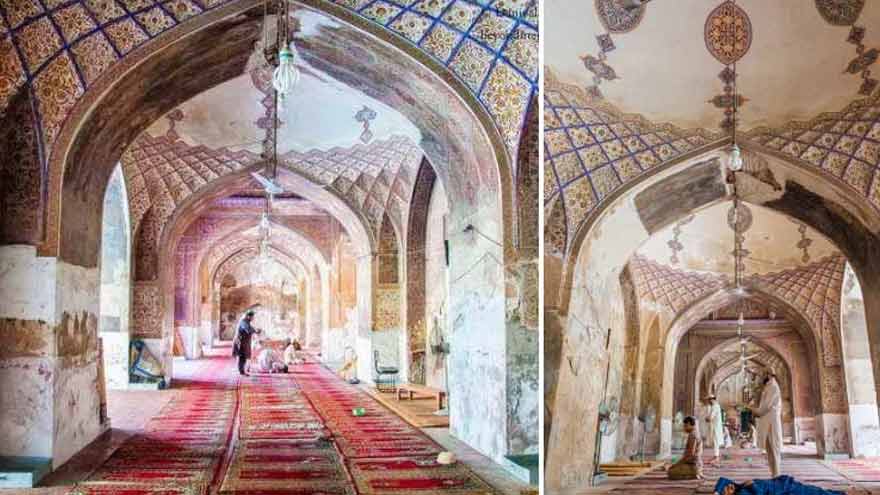
Mariyam Zamani Mosque in Lahore, built in 1614, stands as a key example of early Mughal architecture, known for its five-arched façade, fresco decoration, and historic link with the Mughal court.

LAHORE (Dunya News) - The Mariyam Zamani Mosque, also known as the Begum Shahi Mosque, is considered one of the most important mosques from the Mughal era in Lahore and a significant milestone in the Islamic architectural history of the subcontinent.
Built in 1614 outside the Akbari Gate, directly opposite the Lahore Fort, the mosque is associated with Mariam-uz-Zamani, the wife of Mughal Emperor Akbar.
The mosque is notable not only for its historical significance but also for its unique architecture, decorative features, and prominent location.
Its position directly facing the entrance of the royal fort suggests a close relationship with the Mughal court, indicating that it likely served members of the royal family and court officials.
Architecture
From an architectural perspective, the Mariyam Zamani Mosque represents an early evolutionary phase of Mughal architectural style.
The structure measures approximately 50 meters from east to west and 50 meters from north to south, making it a relatively compact yet well-balanced building.
One of the mosque’s most distinctive features is its five-arched façade, which later became a defining and standard element in many Mughal mosques.
As such, the mosque is considered one of the earliest examples of a design that later influenced the architectural style of Mughal religious structures.
Historians believe the mosque reflects a transitional phase between Lodhi and Mughal architectural styles.
However, since it was built nearly 90 years after the establishment of the Mughal Empire, it is more accurately viewed as a reinterpretation by Mughal architects of traditional Afghan and Sultanate architectural traditions.
Its central pishtaq (arched portal), domed structure, and spacious courtyard demonstrate how Mughal architects adopted earlier Islamic architectural traditions and reshaped them according to their aesthetic ideals.
When compared to the Qila-i-Kuhna Mosque in Delhi, clear similarities appear between the two structures. Qila-i-Kuhna Mosque is also a domed building with five arches and a large courtyard in front.
These shared characteristics highlight how Mughal architecture continued earlier Afghan and Sultanate traditions while introducing distinctive aesthetic features.
Decoration
In terms of decoration, the Mariyam Zamani Mosque stands as a remarkable example of artistic craftsmanship. Inside the mosque, muqarnas-style niches created in plaster, vibrant fresco paintings, and intricate ornamental designs can be found.
Geometric patterns, floral motifs, stylized trees, vases, and bird imagery enhance the interior beauty of the mosque.
Although the exterior decoration has been affected by centuries of weather and environmental conditions, the muqarnas niches within the central arch and the interior frescoes still reflect much of their original splendor.
Historical accounts suggest that the mosque’s fresco decoration was so famous that the eastern gate of Lahore Fort came to be known as “Masjidi” or “Masiti Gate.”
This reflects the artistic prestige and cultural influence of the mosque.
The style of interior decoration closely resembles architectural works from the reign of Jahangir and the early period of Shah Jahan, characterized by balance, restraint, and dignified color schemes.
This artistic approach reflects the refined aesthetic taste of the Mughal court.
Structural Significance
From a structural perspective, the mosque represents a stage in Mughal history when the empire was strengthening its identity and experimenting with architectural forms.
The religious and cultural openness promoted during the reign of Akbar encouraged projects that blended tradition with innovation.
Within this intellectual and artistic environment, buildings such as the Mariyam Zamani Mosque emerged, serving not only as places of worship but also as cultural symbols.
Although Mughal architecture later reached its peak with monumental mosques such as the Badshahi Mosque, the Mariyam Zamani Mosque cannot be overlooked as an early and foundational example. Its simplicity, proportion, and historical significance make it an important reference for understanding the development of Mughal architecture.
Today, the mosque remains an important part of Lahore’s historical heritage and continues to attract researchers, tourists, and photographers. It stands as a reminder that Mughal architecture was not limited to grandeur and magnificence but also emphasized aesthetic balance, spirituality, and artistic detail.
