


Pakistan emerges as strategic economic bridge to link South Asia, Central Asia and Eurasia
Business
Beyond physical roads, the minister emphasized a digital and diplomatic revolution aimed at making trade seamless.

ISLAMABAD (APP) - Federal Minister for Communications Abdul Aleem Khan on Thursday underscored Pakistan’s transformative role as a vital “Economic Bridge” linking South Asia, Central Asia, the Middle East, and Eurasia.
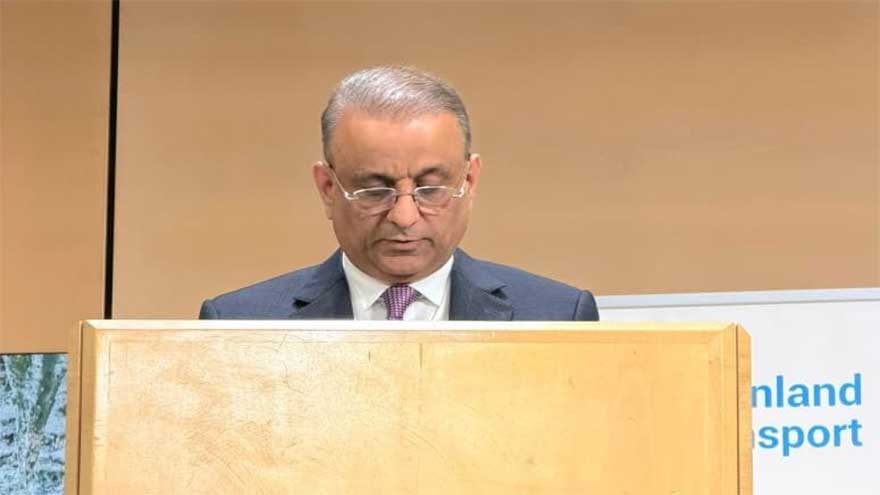
Addressing the 88th session of the UNECE Inland Transport Committee in Geneva, he said that Pakistan’s strategic integration into the Belarus, Russia, and Central Asia corridors represents the dawn of a new era in regional connectivity, said a press release received here.
The minister said that by leveraging the monumental successes of the China-Pakistan Economic Corridor (CPEC), the nation is effectively opening its doors to provide high-efficiency trade routes for Russia and landlocked Central Asian Republics.
Central to this vision is Pakistan’s active facilitation of regional transit trade to the Russian Federation and beyond through six established land corridors, he added. He said that these critical arteries include high-capacity routes via Türkiye, Azerbaijan and Iran as well as specialized China–Kazakhstan connectivity routes.
Furthermore, Pakistan is utilising multiple Trans-Afghan corridors to link with Central Asian Republics and the Quadrilateral Traffic in Transit Agreement (QTTA) route connecting Kazakhstan and Kyrgyzstan with significant scope for northward expansion.
Abdul Aleem Khan said that a milestone in this journey was achieved in June 2024, when the first Kazakh cargo shipment to the UAE successfully transited via Pakistan, proving the country’s logistical viability for intercontinental trade.
Highlighting Pakistan’s world-class logistics, Aleem Khan pointed to the successful execution of over 1,800 TIR operations as concrete evidence of the country’s operational readiness. He invited global stakeholders to capitalize on the M-6 Sukkur–Hyderabad Motorway project, describing it as a premier, high-yield opportunity for international investors. With nearly 30 percent guaranteed equity, this project is set to play a critical role in enhancing regional connectivity while offering sustainable and predictable returns.
To further cement these ties, Pakistan has allocated a dedicated 100-acre terminal at Gwadar Port specifically for Central Asian states, ensuring that Karachi Port remains a robust gateway to the sea for landlocked neighbors, he added.
Beyond physical roads, the minister emphasized a digital and diplomatic revolution aimed at making trade seamless. The Ministry of Communications is currently spearheading a comprehensive program for traffic data digitalization and transparency, ensuring compliance with international laws and UN conventions.
Combined with the “Visa-on-Arrival” facility for 126 countries and the National Logistics Cell’s (NLC) collaborative efforts with Uzbekistan and Kazakhstan, Pakistan is no longer merely a transit territory. Instead, it has firmly established itself as a proactive hub for global economic activity and a catalyst for a regional trade revolution.
