


Start-of-year price increases seen lifting monthly US consumer inflation in January
Business
The anticipated rise in the Consumer Price Index would also reflect the continued pass-through from President Donald Trump's broad tariffs, economists said

WASHINGTON (Reuters) – US consumer prices likely maintained a steady pace of increase in January as businesses raised prices at the start of the year, which together with a stabilising labour market could allow the Federal Reserve to keep interest rates unchanged for a while.
The anticipated rise in the Consumer Price Index would also reflect the continued pass-through from President Donald Trump's broad tariffs, economists said. The Labour Department's consumer inflation report on Friday would follow on the heels of news this week of an acceleration in job growth in January and the unemployment rate falling to 4.3% from 4.4% in December.
"Firms tend to raise prices at the beginning of the year, after the holiday season," said Diego Anzoategui, an economist at Morgan Stanley. "Seasonal factors do not fully eliminate this pattern, so seasonally adjusted inflation prints tend to come in higher than during the rest of the year."
The CPI likely increased by 0.3% after a similar gain in December, a Reuters survey of economists predicted. Estimates ranged from a 0.1% gain to a 0.4% rise. With January's CPI report, the Labour Department's Bureau of Labour Statistics will publish recalculated seasonal adjustment factors to reflect 2025 price movements. That could result in revisions to seasonally adjusted indexes for the past five years.
Economists said they did not expect the updated seasonal factors, the model used by the BLS to strip out seasonal fluctuation from the data, to resolve the so-called January effect. CPI numbers have overshot expectations every January.
The report was slightly delayed by last week's three-day shutdown of the federal government. A longer shutdown last year prevented the collection of prices for October, causing volatility in the CPI data. Economists expected the volatility to fade in January's report.
In the 12 months through January, the CPI is forecast to have advanced 2.5%. The anticipated slowdown in the year-on-year inflation rate from 2.7% in December would mostly reflect last year's higher readings dropping out of the calculation.
The US central bank tracks the Personal Consumption Expenditures Price Indexes for its 2% inflation target. Both measures are running well above target. The Fed last month left its benchmark overnight interest rate in the 3.50%-3.75% range.
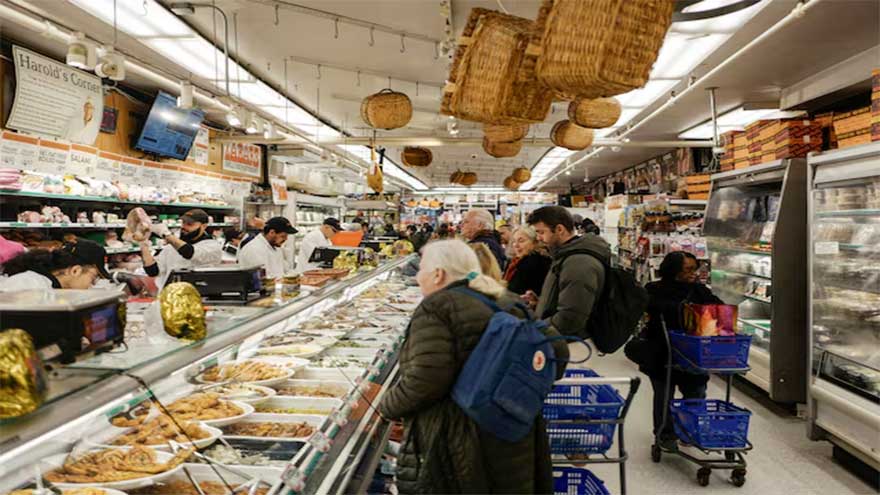
Food prices likely rose further in January after surging 0.7% in December, attributed by some economists to the failure to collect prices during last year's longest shutdown in history. Moves by the Trump administration to roll back and cut tariffs on some imported food, including vegetables and bananas, were likely to ease food price pressures, economists said.
Some also noted that the White House's immigration crackdown had skirted undocumented agricultural workers, especially in Republican-led states like Texas and Florida, avoiding severe labour shortages that would have driven food prices much higher.
DATA CENTERS ARE DRIVING UP ELECTRICITY PRICES
"While many migrant workers have likely left over fears of deportation, and the flow of new workers has slowed sharply, immigration policies have not had as much impact on farm labor as many had feared," said Dean Baker, senior fellow at the Center for Economic and Policy Research.
Though gasoline prices likely fell, the cost of electricity is expected to have increased because of strong demand from data centers to power artificial intelligence.
Excluding the volatile food and energy components, the CPI is expected to have increased 0.3% after rising 0.2% in December. Economists expected the one-off turn-of-the-year price hikes would be evident in prescription medication and motor vehicle insurance categories among others.
They also anticipated the tariff pass-through to persist for goods like recreation, apparel and household furnishings.
"With demand holding firm, we see no compelling reason for companies to stop passing tariff costs through to consumers with only 40% of the cost increase clawed back," said Andy Schneider, a senior US economist at BNP Paribas.
Services inflation components were expected to show mixed readings, with some economists predicting a moderation in the pace of price increases for hotel and motel rooms as well as airline fares after they soared in December.
Rent and healthcare costs are forecast to have maintained the same pace of solid gains in January.
In the 12 months through January, the so-called core CPI was forecast to have increased 2.5% after advancing 2.6% in December. That would also reflect last year's higher readings dropping out of the calculation.
"Keeping in mind indications that additional tariff-related costs will pass through onto consumers this year, as well as the potential pass-through of the sustained weakening of the trade-weighted US dollar over the past year, we continue to expect that inflation will re-accelerate for a time this year," economists at JPMorgan wrote in a note.
