Summary "I will always be by the side of women," she said. As secretary-general her job would be to ensure UN agendas on women's rights are implemented, the two-time president of Chile added
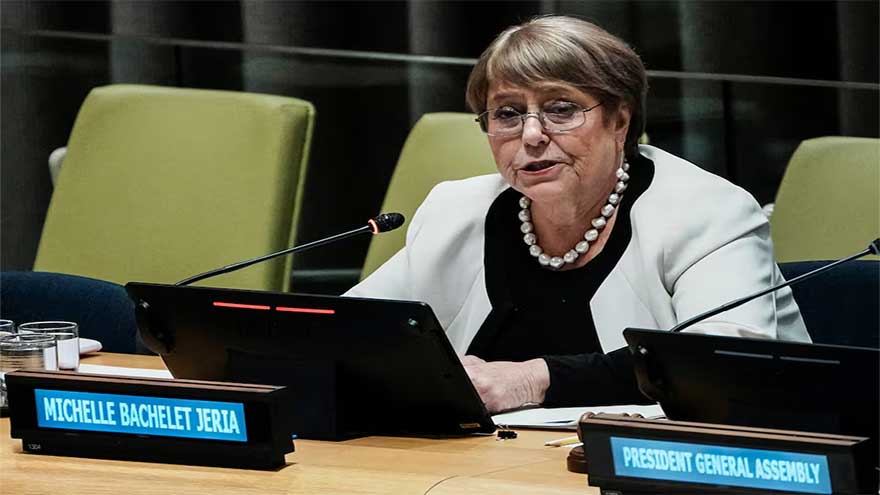
(Reuters) – Chile's former president, Michelle Bachelet, underlined her support for women's rights in her bid to head the United Nations on Tuesday, despite calls for Washington to veto her candidacy due to her support for abortion.
Bachelet, 74, one of four candidates vying to head the 193-member global organization from next year, told reporters she had read a letter from more than two dozen Republican US lawmakers accusing her of having "prioritized an extreme abortion agenda" and calling for the US veto.
"I will always be by the side of women," the two-time president of Chile and a former UN High Commissioner for Human Rights said, adding that as secretary-general her job would be to ensure UN agendas on women's rights are implemented.
"We need to continue advancing on women's rights," she said after a three-hour live hearing on her bid at the UN in New York.
Washington's UN envoy, Mike Waltz, this month appeared to torpedo Bachelet's bid by saying he shared concerns about her suitability.
Bachelet is up against Argentina's Rafael Grossi, Costa Rica's Rebeca Grynspan and Senegal's Macky Sall for a five-year term, which can be extended for another five.
While they are the only declared candidates so far, others can join in the race in the coming months.
NEXT UN LEADER FACES ENORMOUS TASK
The next UN leader will face an enormous task to revitalize an organization in crisis, whose stature has significantly diminished in recent years.
Major powers, even as they increasingly flout long-held norms of international order, have pressed the UN to reform, slash costs, and prove its relevance.
Grossi, a 65-year-old career diplomat and father of eight who speaks English, Spanish, French and Italian, has headed the UN nuclear watchdog for six years. He told his hearing before representatives of UN member states and civil society that reform was going in the right direction, but was just a start.
"This house was not created to be an institution propelling messages from an ivory tower," he said. "It is supposed to be solving problems on the ground."
"We have to convince everybody that the UN is the best possible investment, much better than wars and cheaper as well."
Grynspan and Sall will be questioned on Wednesday.
NO WOMAN HAS EVER HEADED UN
There are far fewer candidates than in 2016, when Antonio Guterres of Portugal was chosen from a field of 13 contenders.
No woman has headed the UN in its 80-year history, and tradition has dictated that the role rotate between regions, with Latin America next in line.
Another unwritten rule is that a secretary-general never comes from among the five permanent members of the UN Security Council – Britain, China, France, Russia and the United States – to avoid over-concentration of power, though their backing is crucial in a lengthy and arcane selection process.
In March, Bachelet's own country withdrew its backing for her candidacy after a right-wing shift in leadership, but she has retained support from Brazil and Mexico.
Grynspan, 70, a former Costa Rican vice president who heads the UN Conference on Trade and Development, depicts herself as a reform-minded multilateralist who has battled gender barriers.
"I am not waiting for special treatment. I want equal treatment," she told Reuters.
Sall, 64, Senegal's president for 12 years until 2024, is a geologist and son of a peanut seller.
Soft-spoken and more comfortable in French than English, he has championed African development and support for debt-burdened countries. "More than ever, a reinvented multilateralism remains the best way to respond to the challenges of a world in full transformation," he said on X.