Summary Lebanon’s government, led by Aoun and Prime Minister Nawaf Salam, has pushed for negotiations despite opposition from Hezbollah
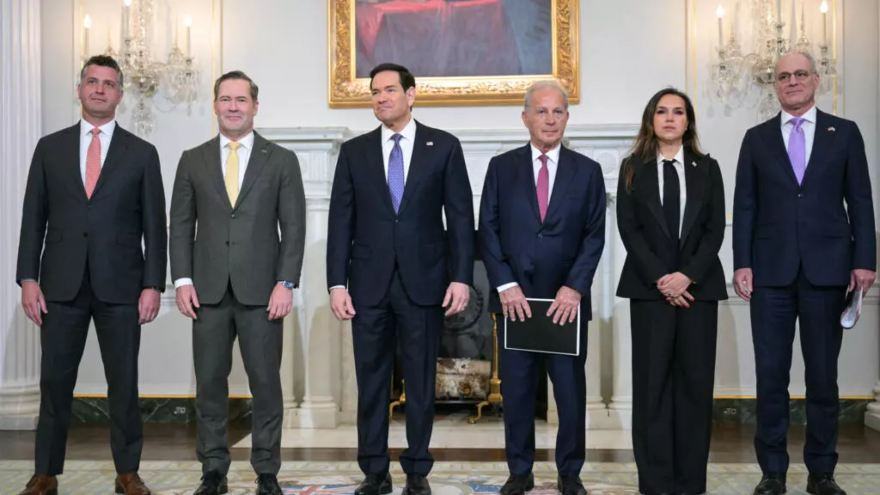
WASHINGTON (Reuters/AFP) – US Secretary of State Marco Rubio hosted a rare round of direct talks between Israeli and Lebanese envoys in Washington on Tuesday, describing the meeting as a “historic opportunity” to lay the groundwork for a lasting peace, even as deep divisions between the two sides remained.
The talks – the first such direct engagement since 1983 – brought together Israel’s ambassador to the United States, Yechiel Leiter, and Lebanon’s envoy Nada Hamadeh Moawad at the State Department, signalling a renewed push by President Donald Trump’s administration to de-escalate tensions in the region.
Rubio said the meeting was not a one-off event but the start of a longer process. “This is a historic opportunity… The hope today is that we can outline a framework upon which a current and lasting peace can be developed,” he said, while acknowledging the complexity of decades-long hostilities between the two countries, which have technically remained at war since 1948.
The meeting comes at a critical moment in the broader Middle East crisis, following a fragile ceasefire involving the United States, Israel and Iran. The conflict, which escalated after US-Israeli strikes on Iran on February 28, has disrupted global oil supplies and intensified diplomatic efforts to prevent further escalation.
However, the Israeli and Lebanese sides entered the talks with sharply different priorities. Lebanon is seeking an immediate ceasefire, while Israel has ruled out discussing a halt to hostilities and is instead pressing for the disarmament of Hezbollah before any broader agreement can be reached.
Lebanese President Joseph Aoun said he hoped the Washington meeting would mark “the beginning of ending the suffering of the Lebanese people,” particularly in the country’s south. Lebanese officials said Moawad’s mandate at the talks was limited to negotiating a ceasefire.
On the Israeli side, Foreign Minister Gideon Saar said discussions would focus on dismantling Hezbollah’s military capabilities, which he described as essential for both Israel’s security and Lebanon’s sovereignty. “We want to reach peace and normalisation with the state of Lebanon,” he said, stressing that disarmament must precede any agreement.
Israeli Prime Minister Benjamin Netanyahu has similarly called for the removal of Hezbollah’s weapons and a durable peace deal “that will last for generations”.
Hezbollah, the Iran-aligned group at the centre of the conflict, rejected the talks outright, calling them “futile”, and warned of continued resistance. The Israeli military said it expected an increase in attacks targeting northern Israel as the Washington meeting took place.
Fighting intensified after Hezbollah launched attacks on March 2 in support of Tehran, drawing Lebanon deeper into the regional conflict. Since then, Israeli strikes – including heavy bombardment of Beirut’s southern suburbs – have killed more than 2,000 people and displaced around 1.2 million, according to Lebanese authorities.

Lebanon’s government, led by Aoun and Prime Minister Nawaf Salam, has pushed for negotiations despite opposition from Hezbollah, highlighting growing internal tensions. The state has long sought to disarm the group peacefully, wary that any forced attempt could trigger renewed civil conflict in a country still scarred by the 1975-1990 civil war.
The Trump administration has maintained that any resolution must include Hezbollah’s disarmament, while also affirming Lebanon’s territorial integrity and Israel’s security – positions widely seen as difficult to reconcile.
Despite the diplomatic push, expectations for an immediate breakthrough remain low. A former Israeli defence official said it would take “a lot of imagination and optimism” to resolve the core disputes quickly, underscoring the challenges facing what US officials describe as the beginning of a longer, uncertain process.