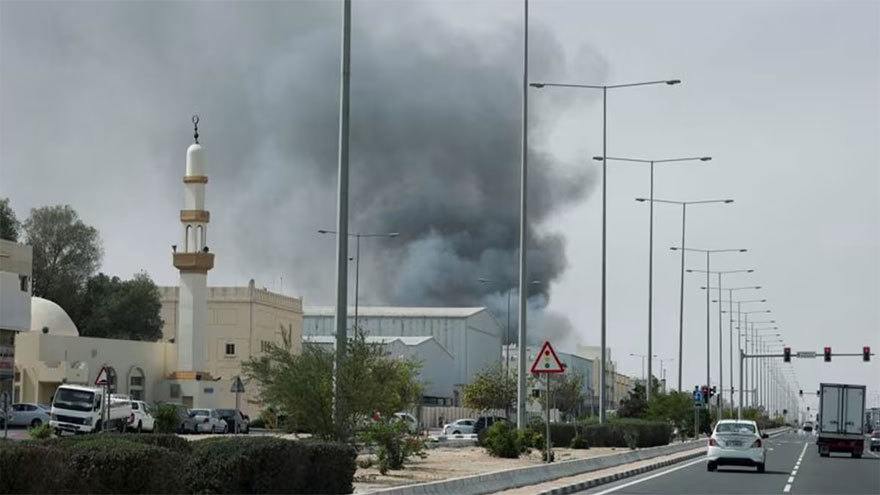
Summary Qatar's foreign ministry has condemned what it called a "brutal Iranian attack targeting Ras Laffan" saying it represented a "direct threat to its national security"
DOHA (AFP) - Iranian strikes caused "extensive damage" at the world's largest gas hub in Qatar, the Gulf state's energy firm said Thursday (Mar 19), and an AFP journalist saw a vast fire illuminating the night sky, visible from roughly 30km away.
Earlier, Tehran had vowed to target energy infrastructure across the Gulf following a US-Israeli attack on its own facilities.
The Gulf has borne the brunt of Iran's reprisals for the US-Israeli strikes that sparked the Middle East war, with Tehran targeting US assets but also striking energy facilities, to the fury of the hydrocarbon-rich monarchies.
And the attacks came as Saudi Arabia was hosting foreign ministers from across the Arab and Islamic world for talks in Riyadh to discuss the fallout from the Middle East war.
QatarEnergy said emergency teams had been "deployed immediately to contain the resulting fires" at the Ras Laffan facility on the tiny Gulf state's north coast after it was "the subject of missile attacks".
In a statement, Qatar's foreign ministry condemned what it called a "brutal Iranian attack targeting Ras Laffan" saying the targeting represented a "direct threat to its national security".
Later, the ministry said Iran's military and security attaches and their staff had been ordered to leave the country within 24 hours.
"UNCONTROLLABLE CONSEQUENCES"
Doha's defence ministry said its air defences intercepted two Iranian ballistic missiles targeting Ras Laffan with no reported casualties and civil defence said the fire had been brought under control.
The incident came hours after US-Israeli strikes hit Iranian facilities on the opposite side of the massive South Pars gas reservoir shared by Iran and Qatar, prompting Iran's President Masoud Pezeshkian to warn of "uncontrollable consequences" of attacks on energy infrastructure.
Iran later warned it would destroy Gulf energy infrastructure if further strikes hit its own energy sector, state media reported.
In a statement, Iran's Revolutionary Guards vowed further attacks "until it is completely destroyed", and a "much more severe" response.
Iran launched salvos of drones and missiles towards the Gulf states on Wednesday evening with several strong blasts heard in the Saudi capital Riyadh, according to AFP journalists, and a missile threat intercepted in the UAE, according to authorities.
Four people were injured when shrapnel from a ballistic missile interception fell on a residential area of the Saudi capital Riyadh on Wednesday, the civil defence said
Riyadh's defence ministry said it intercepted four ballistic missiles on Wednesday with a fragment falling near a refinery south of the Saudi capital.
Multiple drones were also intercepted and destroyed as they headed towards Saudi gas facilities in the kingdom's Eastern Province.
"DANGEROUS"
Earlier, Qatar had condemned the attacks on Iran's gas facilities, calling them "dangerous and irresponsible".
Foreign ministry spokesman Majed al-Ansari warned that: "Targeting energy infrastructure constitutes a threat to global energy security, to the peoples of the region, and to its environment."
In a rare rebuke, the UAE also criticised the targeting of the Iranian facilities as a "dangerous escalation".
"Targeting energy infrastructure poses a direct threat to global energy security," Abu Dhabi's foreign ministry said in a statement.
The Israeli military kept silent on Wednesday evening about a strike on the South Pars/North Dome mega-field.
Asked twice by AFP about the allegations, the Israeli military did not respond.
Prior to Wednesday's attacks, Tehran had already sought to knock major Gulf refineries offline while also tightening its chokehold on the strait in a quest to inflict maximum pain on the global economy.
In the past weeks, Saudi Aramco's sprawling Ras Tanura facility, home to one of the Middle East's largest refineries, was targeted as well as the UAE's Ruwais refinery - one of the largest in the world.
Earlier in March, Iranian attacks forced QatarEnergy to halt liquefied natural gas production last week and declare force majeure.
Energy producers in Kuwait made similar declarations, which are a warning that events beyond their control may lead them to miss export targets.