Updated on
Summary A U.N. climate conference reached a hard-fought agreement on Sunday.
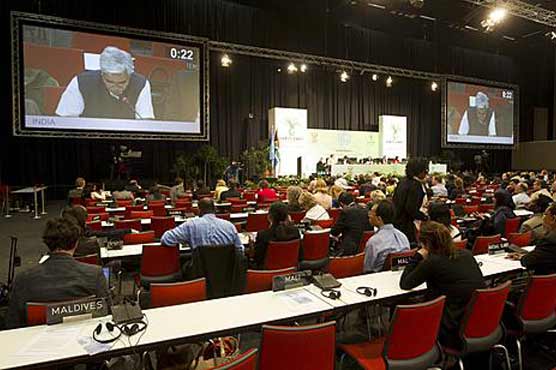
A U.N. climate conference reached a hard-fought agreement on a far-reaching program meant to set a new course for the global fight against climate change.The 194-party conference agreed to start negotiations on a new accord that would ensure that countries will be legally bound to carry out any pledges they make. It would take effect by 2020 at the latest. The deal doesnt explicitly compel any nation to take on emissions targets, although most emerging economies have volunteered to curb the growth of their emissions.Currently, only industrial countries have legally binding emissions targets under the 1997 Kyoto Protocol. Those commitments expire next year, but they will be extended for at least another five years under the accord adopted Sunday a key demand by developing countries seeking to preserve the only existing treaty regulating carbon emissions.The proposed Durban Platform offered answers to problems that have bedeviled global warming negotiations for years about sharing the responsibility for controlling carbon emissions and helping the worlds poorest and most climate-vulnerable nations cope with changing forces of nature. The United States was a reluctant supporter, concerned about agreeing to join an international climate system that likely would find much opposition in the U.S. Congress.This is a very significant package. None of us likes everything in it. Believe me, there is plenty the United States is not thrilled about, said U.S. climate envoy Todd Stern. But the package captured important advances that would be undone if it is rejected, he told the delegates.Sundays deal also set up the bodies that will collect, govern and distribute tens of billions of dollars a year for poor countries. Other documents in the package lay out rules for monitoring and verifying emissions reductions, protecting forests, transferring clean technologies to developing countries and scores of technical issues.U.N. Secretary General Ban Ki-moon said the deal represents an important advance in our work on climate change. But the deals language left some analysts warning that the wording left huge loopholes for countries to avoid tying their emissions to legal constraints, and noted that there was no mention of penalties. They havent reached a real deal, said Samantha Smith, of WWF International. They watered things down so everyone could get on board.Environmentalists criticized the package as did many developing countries in the debate for failing to address what they called the most urgent issue, to move faster and deeper in cutting carbon emissions.The good news is we avoided a train wreck, said Alden Meyer, recalling predictions a few days ago of a likely failure. The bad news is that we did very little here to affect the emissions curve.Scientists say that unless those emissions chiefly carbon dioxide from power generation and industry level out and reverse within a few years, the Earth will be set on a possibly irreversible path of rising temperatures that lead to ever greater climate catastrophes.Sundays breakthrough capped 13 days of hectic negotiations that ran a day and a half over schedule, including two round-the-clock days that left negotiators bleary-eyed and stumbling with words. Delegates were seen nodding off in the final plenary session, despite the high drama, barely constrained emotions and uncertainty whether the talks would end in triumph or total collapse.The nearly fatal issue involved the legal nature of the accord that will govern carbon emissions by the turn of the next decade. A plan put forward by the European Union sought strong language that would bind all countries equally to carry out their emissions commitments.India led the objectors, saying it wanted a less rigorous option. Environment Minister Jayanthi Natarajan argued that the EU proposal undermined the 20-year-old principle that developing countries have less responsibility than industrial nations that caused the global warming problem through 200 years of pollution.The equity of burden-sharing cannot be shifted, she said in angry tones.Chinese negotiator Xie Zhenhua gave heated support for the Indians, saying the industrial nations have not lived up to their promises while China and other developing countries had launched ambitious green programs.We are doing whatever we should do. We are doing things you are not doing. What qualifies you to say things like this, he said, raising his voice and waving his arm. The debate ran past midnight and grew increasingly tense as speakers lined up almost evenly on one side or the other. Conference president Maite Nkoana-Mashabane, who is South Africas foreign minister, called a recess and told the EU and Indian delegates to put their heads together and come up with a compromise formula.Coming after weeks of unsuccessful effort to resolve the issue, Nkoana-Mashabane gave Natarajan and European Commissioner Connie Hedegaard 10 minutes to find a solution, with hundreds of delegates milling around them.
Featured