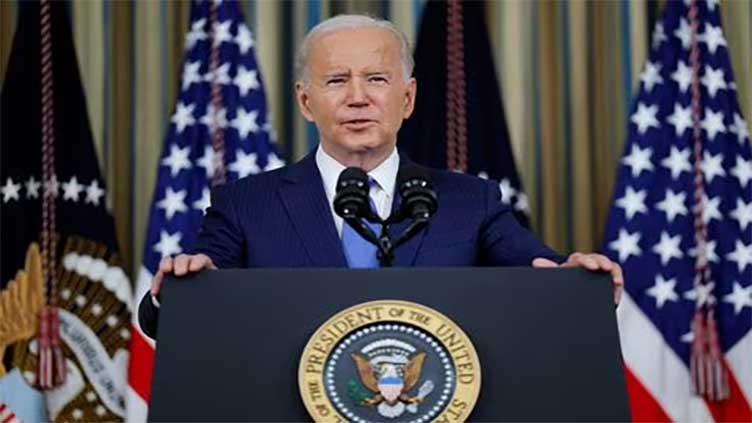
Summary Some Black men lose faith in Biden, Democrats in 2024
WASHINGTON (Reuters) - Bahta Mekonnen, a 28-year-old U.S. Army captain from the key voting state of Georgia, is among the millions of Black voters who helped deliver President Joe Biden the White House in 2020.
Three years later, he is one of the voters who Democrats fear could cost Biden a second term in 2024.
Disappointed by what he sees as Democrats' lurch to the left, free spending and empty promises, but also turned off by far-right Republicans, Mekonnen says he sees nothing but bad options at the ballot box next year.
"What I'm noticing across the Democratic Party right now is there's a lot of pandering to the Black community," he said. "It seems like they do a lot to try to make it seem like they are the party for young Black men or Black men as a whole, but they don't back it with anything. They don't follow through."
Long the most loyal Democratic constituency, Black voters played a large role in rescuing Biden's struggling 2020 presidential campaign in the South Carolina primary, and sending him to the White House with Democrats in control of the Senate, thanks to further success in Georgia.
In return, many Black voters expected Biden and Democrats to push new federal protections against restrictive local voting laws, police and criminal justice reform, student loan debt relief and economic empowerment.
Many of those efforts have been blocked by Republicans, leaving Biden to ask voters to let him "finish this job," with a second term, but with no clear path to get these things done.
On the other hand, Democrats' focus on LGBTQ and abortion rights leaves voters like Mekonnen feeling alienated.
"I'm probably getting turned away from the left, just because the Democrats are turning more left in my books," he said, adding he wished Democrats spent more time on the economy.
Polls and Reuters interviews show younger Black voters and Black men of all ages are losing their faith in Democrats, Biden and perhaps even the political process, just three years after the U.S.'s biggest protests for racial justice and civil rights in a generation.
The vast majority of Black voters, including men, are still expected to choose Biden over a Republican.
But the question for Democrats is whether disillusioned Black voters will turn out to the polls in large enough numbers in crucial cities, from Philadelphia to Atlanta, Milwaukee and Detroit to keep Biden in the White House.
"Democrats need to understand that there is a growing population, especially with Black men, who are reaching the point of being fed up with always being pushed over and looked over," said LeLann Evans, 33, a political campaign manager who is running as a write-in candidate for Nashville City Council.
Democrats' failure to secure widespread student loan relief or legalize marijuana has been disappointing, Evans said, adding that Republicans' more aggressive approach when they have power means they are "actually getting things done."
TURNOUT DROPS
Self-identified Black Americans make up 14.2% of the U.S. population, or 42.7 million people, a 30% jump from 2000, Pew Research shows. These Americans are five years younger than the population as a whole, with an average age of 33, and Democrats' earning their loyalty is crucial for the party to keep winning in Pennsylvania, Michigan and Georgia, and to recapture districts in the South in the future.
Instead the opposite is happening.
Black voter turnout dropped by nearly 10 percentage points, from 51.7% in the 2018 midterm elections to 42% in 2022, according to a Washington Post analysis of the U.S. Census Bureau's survey released earlier this year. White voter turnout slipped by only 1.5 points to 53.4%.