Updated on
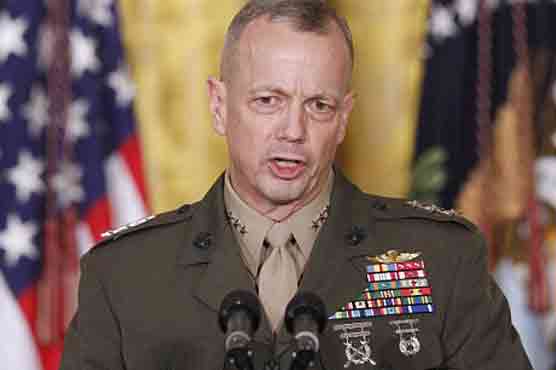
Summary General Allen says biggest challenge is attacks on his troops by fighters coming from safe havens.
It makes me mad every day but, look, I got to deal with what I can deal with, and I deal with it as it comes to the border, John Allen, eighth US commander in charge of Afghan war, was quoted by a report as saying.Pakistan on its part has been suffering from rising number of cross-border attacks. The statements by Kabul and NATO forces however continue to paint the picture the other way.Allen, who is charged not only with fighting the unpopular war in Afghanistan, but also bringing it to an end, said that the problem with safe havens has gotten worse in the past ten years, an indirect admission of the fact that the US has lost war in Afghanistan.That’s a question we have to ask the Pakistanis, in the end, he said in yet the statements of a kind that blame Pakistan for the US failure. My mandate ends at the border and I’ll deal with the Taliban and the Haqqanis as they come across.The problem is, of course, the Taliban are a very large organization. It’s a syndicate, almost a criminal syndicate in so many ways. Nobody really knows how many there are. Our [intelligence] estimates would put them between 25 and maybe 30,000, max. But they are distributed all over, he said.Some of them are in the safe havens where they have an opportunity to rest and refit. Some of them are in transit and many are only in support roles and then some are gun toting, infantry, they are measured in the thousands on any given day, he said while self-contradicting his earlier statement that expressed vagueness even about the number of the Taliban.In the end, Allen however came to what all US officials these day. He said that the United States is seeking a constructive relationship with Pakistan.There’s much worse than a bad relationship with Pakistan, which is no relationship with Pakistan, he said.There are complicated dimensions to the relationship between Pakistan and Afghanistan, and Pakistan and the United States, and Pakistan and the international community. It’s a complicated and multilayered development, he said, as if speaking of algebra.