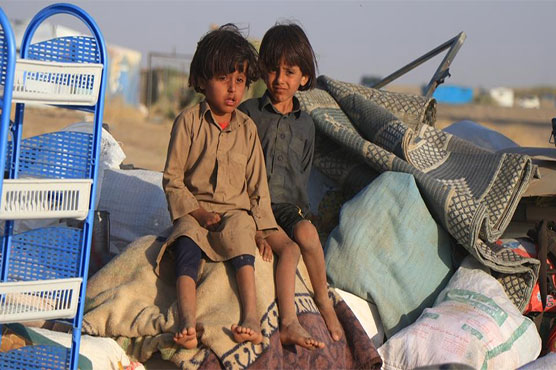
Summary A Huthi rebel advance near Yemen's lifeline port of Hodeida has displaced more than 6,000 people.
HODEIDA (AFP) - A Huthi rebel advance near Yemen s lifeline port of Hodeida and a Saudi pullback have displaced more than 6,000 people, the United Nations said.
The Iran-backed insurgents on Friday took control of a large area south of Hodeida, a key Red Sea port where the warring sides agreed on a ceasefire in 2018, after loyalist forces withdrew.
The United Nations Mission to support the Hodeida Agreement (UNMHA) said Monday that the latest developments "represent a major shift of the frontlines".
The Saudi-led coalition said in a statement that the "redeployment and repositioning" of its troops and government forces last week was designed "to support the Yemeni government in its national battle on all fronts".
It is a possible reference to heavy battles on the separate front for the city of Marib, the government s last stronghold in the north.
"Some 700 families (some 4,900 people) were displaced" to Khokha, over 100 kilometres (60 miles) south of Hodeida, the UN Office for the Coordination of Humanitarian Affairs (OCHA) said, citing Yemeni government sources.
It said "184 other families (about 1,300 people) were displaced further south" to the coastal town of Mokha.
"No displacement has been reported within the areas that came under control of the de facto authorities," OCHA said in a statement Sunday, referring to the Shiite Huthis.
- Battle for Marib rages -
Citing aid partners on the ground, it said a 300-tent site for displaced people had been set up in Khokha, while authorities were reportedly seeking another site to cope with the influx.
But the UN also said the Huthi advance could result in "improved movement for civilians" between the provinces of Hodeida and the rebel-held capital Sanaa, and along roads connecting Hodeida city with other districts.
It urged all parties "to protect civilians especially internally displaced persons".
The Hodeida ceasefire was agreed at Yemen s last peace talks in Sweden in 2018.
But clashes have since broken out between rebels and pro-government troops around the city, which is vital for the import of humanitarian aid.
Two military officials told AFP that fighting also erupted Saturday when the rebels tried to push south into government-controlled territory, but loyalist forces had repelled the advance.
The Saudi-led coalition intervened in Yemen in 2015 to shore up the government, a year after the Huthis seized the capital Sanaa.
Tens of thousands of people, mostly civilians, have been killed and millions displaced in Yemen s conflict, in what the UN calls the world s worst humanitarian crisis.
The Huthi insurgents have also kept an offensive to capture Marib. They began a major push to seize Marib city in February, and renewed their offensive in September.
The coalition said Monday that it killed more than 140 Huthi insurgents in the past 24 hours in air strikes in the provinces of Marib and Al-Bayda, to the south.
The coalition has been reporting high death tolls in almost daily strikes since October aimed at repelling the rebel offensive on Marib.
The Huthis rarely comment on the tolls, which have exceeded 3,500 in the past weeks, according to Saudi reports.
AFP cannot independently verify the coalition s figures.
"Eighteen military vehicles were destroyed and over 140 terrorist elements eliminated" in the latest raids, the coalition said, quoted by the Saudi state news agency SPA.
The UN last week called on "all parties to the conflict to ensure the safety and security of civilians in and around those areas where shifts in frontlines have taken place".