
Updated on
Summary One person was killed and 33 wounded when a bomb ripped through a Jerusalem bus on Wednesday.
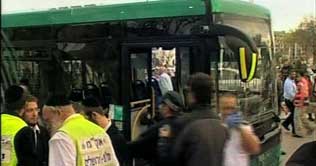
Police and officials said the bomb had been hidden in a bag at a bus stop near Jerusalems central bus station at the western entrance to the Holy City. Several hours after the blast, a woman who was critically wounded in the attack died of her injuries, Israeli radio and television stations said, citing officials at the Hadassa hospital in Ein Kerem. US Defence Secretary Robert Gates in Cairo condemned the blast as a horrific terrorist attack.Police spokesman Micky Rosenfeld said 35 people had been wounded in the blast, which was the first major bombing in Jerusalem since September 2004, when a teenager bomber blew herself up killing two at a bus stop in French Hill, a settlement neighbourhood in east Jerusalem. Of the wounded in Wednesdays attack, at least three people were said to be in serious condition, and around five sustained moderate injuries, medics said, with many suffering from shrapnel wounds.The explosion, which shook buildings hundreds of metres (yards) away, hit the number 74 bus as it stopped to pick up passengers at a stop between the central bus station and the ICC conference centre. Sirens echoed through the city as dozens of ambulances and police cars raced to the scene, a transit hub through which well over a thousand buses pass every day.Following the attack, Israeli Prime Minister Benjamin Netanyahu delayed by four hours his departure for Moscow where he is due to hold talks with Russian President Dmitry Medvedev and Prime Minister Vladimir Putin.Israeli raids had on Tuesday killed eight Gazans, two of them minors, prompting threats of revenge by the Al-Quds Brigades, the armed wing of Islamic Jihad, to strike ever deeper inside Israel.Earlier on Wednesday, Netanyahu had warned it could take an exchange of blows to put the militants out of action. Defence Minister Ehud Barak, who is currently in the United States, said Israel would not tolerate any attacks, be they in Jerusalem or against towns and cities in the south.


