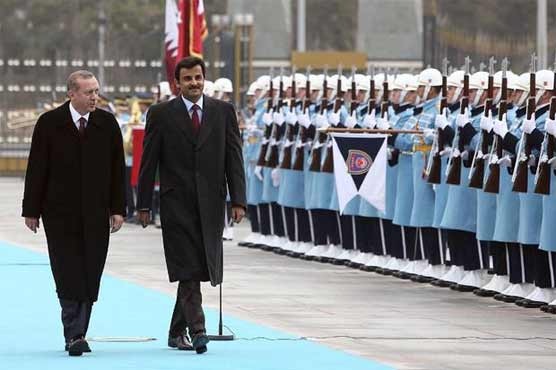
Summary Qatari Crown Prince and Turkish President in Ankara in 2014 (AFP)
(Aqsa Sajjad) - Barely two days had passed since Saudi Arabia, Bahrain and UAE cut off diplomatic ties with Qatar that Turkey’s parliament approved a legislation allowing its troops to be deployed to a Turkish military base in Qatar. Another bill approving an accord between the two countries on military training cooperation was also ratified. The bill approving troop deployment was first drafted in May and passed with 240 votes in favour, largely with support from the ruling Justice and Development Party (AKP) and the nationalist opposition MHP. Both bills, in fact, were drafted before the crisis erupted and were brought forward by AKP MPs in an extraordinary session of the parliament.
Turkish analysts see this as an apparent move by Ankara to show support for Doha.

The crisis is putting old alliances and enmities to test and when it is over, it would have revealed a string of new ones. Initially, Erdogan was quick in trying to diffuse the tensions by making phone calls to Russian President Vladimir Putin, Saudi Arabia’s King Salman bin Abdul-Aziz Al Saud, and the Emirs of Qatar and Kuwait.
Ankara’s initial reaction, though not altogether anti-Saudi Arabia, is pro-Qatar. Does this mean Ankara is ready to protect Doha at the expense of its relations with Saudi Arabia? Economically speaking, can Turkey afford such a position? A look into some key considerations for Turkey can help find answers to the question of Turkey’s stance in the crisis.
When it comes to picking sides, Turkey can find itself in somewhat of a dilemma. It is important not to read Turkey’s decision of troop deployment as ‘picking a side’ in the GCC-Qatar crisis.
The first key consideration for Turkey is its good economic and political ties with Qatar. Turkey and Qatar have a long history of being on the same side of regional conflicts and developments. Both countries share similar views on the Syrian crisis and the Muslim Brotherhood while simultaneously trying to maintain good relations with Saudi Arabia and other Gulf countries. On subjects like Palestine, Hamas and Egypt, the two countries are on the same page. Both countries provided support to the Egyptian uprising and condemned the military coup that brought the current president Abdel Fateh-el Sisi to power. Both countries have also refused to classify the Muslim Brotherhood as a terrorist organization and, alongside Russia, have backed rebels fighting to overthrow President Bashar al-Assad in Syria.
Ankara and Doha have been working on defense cooperation since 2014, when both nations signed an agreement to help them confront “common enemies”. A small Turkish military consignment is already deployed in Qatar since 2015. Qatar also showed strong support for the Turkish government during last July’s attempted military coup. Turkey ranks seventh in terms of Qatar’s foreign investments and has taken on construction contracts valued at over $14 billion in the country. Meanwhile, Turkish exports to Qatar are valued at over $400 million.
The second key consideration for Turkey is that the Saudi-led alliance against Qatar comprises of countries all of which form an anti-Iranian Sunni bloc. Turkey has tense relations with Iran due to fundamental differences over Syria and Iraq but the two countries have steered away from major crisis. Their differences did not stop the Iranian Foreign Minister from visiting Turkey or affected the trade relation between the two countries. Turkey and Qatar have both showed a similar approach to Iran with strong trade ties and an apparent unwillingness to have any confrontation.
Yesilada, a political analyst, explains Turkey’s relationship with Iran: "Turkey is in loggerheads with Iran in Iraq and Syria, but it is also continuing its growing trade relationship with this Iran - and this compartmentalised relationship is making Riyadh question the strength of Turkey s position in the alliance that is forming against Iran in the Middle East".
The third key consideration for Turkey is its strong ties with the Muslim Brotherhood which is seen by Saudi Arabia and Egypt as a terrorist organization. The two countries along with UAE have accused Turkey of supporting radical Islamist groups. Turkey considers the Muslim Brotherhood to be a kindred organization and there are speculations that Ankara has been lobbying Washington to prevent it from declaring the Brotherhood as a terrorist organization.
The fourth key consideration for Turkey is its strong economic relations with KSA. Last April, the two countries signed an agreement to form a team specifically for strengthening bilateral trade ties. Turkey is also aware of the growing friendship between Saudi Arabia and the new US administration. It sees Riyadh as a new channel for dialogue with the US with whom it has often shared tense relations in the past.
The GCC crisis has put Turkey in a delicate position. In essence, Turkey has little to do with the GCC-Qatar crisis and should remain neutral. Most foreign policy analysts in Turkey agree that the country is already seriously isolated and taking sides in the crisis will only increase this isolation. Turkey’s current inclination towards Qatar can lead to accusations from the West and the Gulf of supporting terrorism, further isolating Turkey. Maintaining good relations with Qatar and Saudi Arabia at the same time is becoming increasing impossible for Turkey. In the national interest of Ankara, a neutral stance seems to be the most beneficial at this point in time.
Written by Aqsa Sajjad