Updated on
Summary
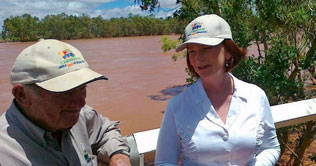
Australian Prime Minister Julia Gillard announced a new 1.8 billion Australian dollar (US$1.79 billion) income tax to help fund reconstruction in flood-devastated Queensland state without tipping the government budget further into deficit. With a slender grip on power after last year's election left neither of Australia's two major political forces with enough seats to govern alone, Ms. Gillard's handling of the flood recovery will be pivotal for the Labor government. It comes as Canberra begins counting the clean-up cost of its worst natural disaster in decades, estimated by officials Thursday to trim about A$5.6 billion from the government budget and cut economic growth by half a percentage point in the fiscal year ending June 30. The proposed year-long temporary tax hit the Australian dollar Thursday, sending it down to US$0.9964 from US$0.9997 during the Asian trading day, on the belief that it could have a dampening effect on consumer spending and take pressure off Australia's central bank to raise rates. Australian stocks ended flat.The temporary tax, to apply to the fiscal year beginning July 1 to Australians earning over A$50,000 a year, will cost around A$1 a week for someone on an annual income of A$60,000, rising to A$5 a week for someone earning A$100,000 a year. In announcing the tax, Ms. Gillard is judging that the political cost of not delivering on a promise to restore the budget to surplus by the year ending June 30, 2013, would be greater than any voter backlash against higher taxes. The great majority of Australians are ready to contribute, I have no doubt about that, Ms. Gillard said. But Tony Windsor, one of a handful of independent lawmakers keeping the Labor government in power, warned: Don't count on my vote for the new tax. Mr. Windsor is calling for a permanent National Natural Disaster Levy to fund future crises including floods, wild fires, hail storms or cyclones. Another key independent, Robert Oakeshott, is undecided. Meanwhile, the increasingly influential Greens Party said it supports the idea of a flood tax. But it added it opposes Ms. Gillard's proposed spending cuts to other government programsincluding solar hot water rebates and energy efficiency measuresto help fund the recovery costs. That raises the prospect the tax legislation could be voted down when introduced into Parliament next month. It beggars belief that the government would choose to cut climate change programs...to fund disaster relief when such disasters will be made worse by climate change, acting Greens leader Christine Milne said. Joe Hockey, shadow Treasurer for the main conservative Liberal-National opposition coalition, said a tax to fund the flood recovery effort is too much on top of an anticipated rise in food prices as a result of the damage to agricultural land. On top of the recent Labor party increases in the cigarette tax and also alcohol taxes and car taxes and given that electricity prices are rising, it is too much at this point in the economic cycle, Mr. Hockey said. Rick Kuhn, a political expert at Australian National University, described the tax as an incredible act of hypocrisy on the part of the government. It is placing the burden for the flood relief onto ordinary working class taxpayers at a time when the government is going to be cutting the corporate tax rate, he said, referring to plans to cut the company tax rate to 29% from 30% from July 1, 2013. Devastating floods have washed out thousands of homes, roads and rail lines and killed more than 30 people across resource-rich Queensland state since December, disrupting exports and destroying agricultural crops. Australia is the world's largest exporter of coal used for steelmaking and the second largest supplier of coal for power plants. Separate floods spreading across Victoria state over the past two weeks have affected 60 towns in an area larger than Denmark. Ms. Gillard pledged Thursday an immediate government payment of A$2 billion toward the Queensland reconstruction effort, to be funded by cutting spending in other areas and delaying non-urgent infrastructure projects in other states. Australia & New Zealand Banking Group Ltd. economists warned the flood tax will act as another constraint on household spending, reinforcing market expectations that the country's central bank will hold interest rates steady for some time. This federal government flood tax will cost jobs, slow the economy and destroy households that are just hanging on, said Scott O'Driscoll, National President of the United Retail Federation. Woolworths Ltd., one of the country's largest grocery and general-merchandise retailers, this week downgraded guidance for earnings growth this year, partly citing disruptions from the floods. Given the economy already is taking a big hit from higher food prices, rents and insurance premiums, it seems strange that the government wants to take the chance of damaging it further, Macquarie Research Economics director Brian Redican said. These policies increase the risks to the economy recovering in a quick and timely fashion from the flood impact. Economist and Reserve Bank of Australia board member Warwick McKibbin panned the tax proposal as politically motivated, saying that relaxing the government's goal of restoring the budget to surplus in fiscal 2013 is a better option. (WSJ)