Updated on
Summary
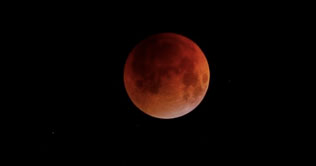
The start of winter is also coming with this year's only total lunar eclipse, which will be visible across all of North America, Greenland, and parts of Europe. It will be the first total lunar eclipse in three years.This year, the moon should have a orangish-red color to it, because it is coincides with the winter solstice. The Moon is normally illuminated by the Sun. During a total lunar eclipse, the full Moon passes through the shadow created by the Earth blocking the Sun's light. Some indirect sunlight will still manage to pierce through and give the Moon a ghostly colour.The west coast of America witnessed the eclipse on Monday night; observers in North and Central America will be able to view the whole event. Western Europe will only see the start of the spectacle while western Asia will catch the tail end.The totality phase - when the moon is entirely inside Earth's shadow - will last a little over an hour.