Summary Chinese People's Liberation Army (PLA) has strongly reacted against this move of India.
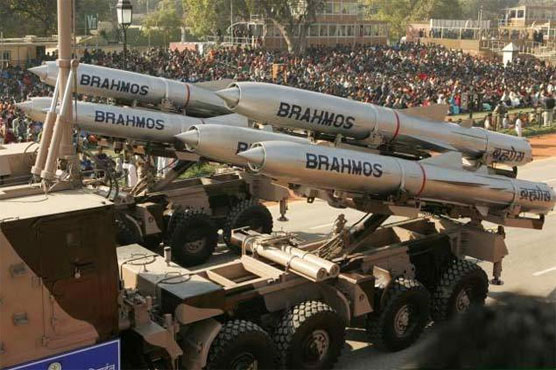
BEIJING (Dunya News / Web Desk) – China has warned India that increasing troop’s presence and move to deploy BrahMos cruise missiles in Arunachal Pradesh can escalate tensions on the border.
Chinese People’s Liberation Army (PLA) has strongly reacted against this move of India.
"India deploying supersonic missiles on the border has exceeded its own needs for self-defense and poses a serious threat to China’s Tibet and Yunnan provinces," said the commentary that was published this weekend in the PLA’s influential official newspaper as reported by India Today.
The Cabinet Committee on Security, chaired by PM Narendra Modi, had cleared this fourth BrahMos regiment at a cost of over Rs 4,300 crore. The regiment consists of around 100 missiles, five mobile autonomous launchers on 12x12 heavy-duty trucks and a mobile command post.
The PLA Daily suggested deploying the BrahMos could threaten some of this infrastructure. "The supersonic BrahMos cruise missile has excellent dive attack capabilities, and fits in the Sino-Indian border where it’s mostly mountain topography," the commentary said, adding that the "low observable" nature and "penetration capabilities" of the 2.5 Mach-speed missile posed a threat to China’s border areas.
The commentary, authored by an expert from the PLA Navy’s Engineering University, also presented a detailed assessment of the nature of the threat posed by the deployment of an advanced version of BrahMos with "steep div"" capabilities suited to mountain warfare.
The deployment of the missile "could increase suddenness and effectivity of attacks" and land "crushing blows on time-sensitive targets like missile launchers and solid targets like command centres", it said.
"Deploying BrahMos missiles is bound to increase competitiveness and confrontation in Sino-Indian relations and bring a negative influence to stability of the region," the commentary concluded. On the other hand, the newspaper suggested, the missile also had certain "defects", such as "a relatively short range that cannot threaten China’s deep zones" as well "a heavy weight that makes it difficult for even a Sukhoi Su-30MKI to carry more than one".