Summary The US-led coalition agreed on a plan to corner the militants in their final bastions.
WASHINGTON (AFP) - The United States gathered its allies in the coalition fighting the Islamic State group on Wednesday and agreed on a plan to corner the militants in their final bastions.
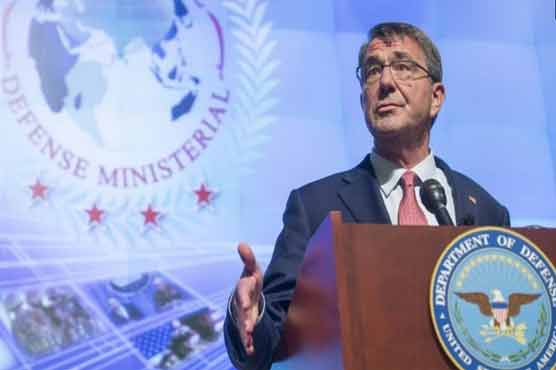
US Defence Secretary Ashton Carter told reporters that an accelerated military effort would soon see the group pushed back to Raqa in Syria and Mosul in Iraq.
He warned that isolating and taking out what he called the IS "parent tumour" would not eliminate its violent ideology or its ability to spring attacks elsewhere.
But defence ministers from the Western and Arab countries of the coalition now have a military plan to liberate the cities with local Iraqi and Syrian forces.
"Today, we made the plans and commitments that will help us deliver ISIL the lasting defeat that it deserves," Carter told reporters at an airbase outside Washington. "Let me be clear: They culminate in the collapse of ISIL s control over the cities of Mosul and Raqa."
Separately, US Secretary of State John Kerry is meeting with foreign ministers from the coalition countries to discuss the broader political and humanitarian plan.
And donor countries were set to pledge what officials hoped would be up to US$2 billion to help civilians return to normal life in liberated areas of Iraq.
Baghdad needs the money to rebuild in areas that have been retaken and enable the population to return.
"The fight against Daesh is obviously far from finished, even as we have progress. Mosul is not yet free. Acts of terrorism remain a constant daily danger," Kerry said.
"But the momentum - there is nobody at this table who would argue that the momentum hasn t shifted - it has shifted," he said, sitting with allied foreign ministers.
"And Daesh has been driven out of almost half of the territory that once occupied in Iraq," he said, using his preferred term for the Islamic State group.
The two days of meetings were called as militant attacks - some of them inspired or ordered by the IS group - are proliferating around the world.
The coalition, and in particular its US leadership, are keen to seize back the narrative and emphasise what they see as progress on the main battlefield.
But their task is complicated by the jihadist violence erupting in French seafront resorts, on German passenger trains and in the streets of Turkey and the Middle East.
In recent weeks, militamts have claimed horrific attacks in Nice, Istanbul, Baghdad and Dhaka that have left hundreds dead and injured.
These are "going to be a primary focus, obviously, of the discussions," acknowledged Brett McGurk, President Barack Obama s special envoy to the anti-IS coalition.
For two days, Kerry and Carter will meet with about 40 of their counterparts in Washington.
French defense minister Jean-Yves le Drian told AFP that the battle for Iraq and Mosul is also key for the future security of Europe s cities.
"Daesh is not only a terrorist army that has seized territory," he said, referring to the swath of desert the group has claimed as a "caliphate" in Iraq and Syria.
"It is also from this territory that it has launched both the operations ordered by terrorists that France has suffered (and) also propaganda efforts."
McGurk also cautioned: "Nobody can say these attacks are going to stop. Unfortunately, I think we are going to see more of these."
The coalition, which has conducted 14,000 strikes in two years, is "succeeding on the ground."
But McGurk said: "We have a lot of work to do on (jihadist) networks."
The problem, said Michael Weiss of the Atlantic Council think tank, is that "at the territorial level ... ISIS is down but not out."
"It has lost its ability to back and hold large swaths of terrain but it has not lost its ability to wage ... opportunistic attacks," he said.
Washington maintains that since its peak in 2014, IS has lost nearly 50 per cent of its Iraqi territory and between 20 and 30 per cent of its Syrian strongholds.
The coalition will also be discussing what comes after IS, particularly in Iraq, the subject of a separate donors meeting on Wednesday.
"Today is the time" for "assisting Iraq in the post-liberation area," Iraqi Foreign Minister Ibrahim al-Jafaari pleaded in Washington.
Iraqi forces that recently retook Fallujah are advancing through the Tigris valley toward Mosul.
They have recaptured the Qayyara air base south of Mosul, which US military officials say will serve as a launch pad for offensive operations against the city.
Washington has also announced that it will send 560 more US troops to Iraq to help the government fight IS and recapture Mosul.
That will bring to 4,600 troops the US military presence in Iraq five years after the United States 2011 military withdrawal.