Summary The day is being commemorated in the memory of those 22 Kashmiris who were shot dead in 1931.
SRINAGAR (Dunya News / AFP) – Martyr’s Day is being observed in occupied Kashmir today (Wednesday).
The day is being commemorated in the memory of those 22 Kashmiris who were shot dead in 1931 by the Dogra troops outside the Central Jail in Srinagar.
 Volunteers carry an injured man shot during clashes between security forces and protesters in Srinagar from an ambulance outside a hospital in the city
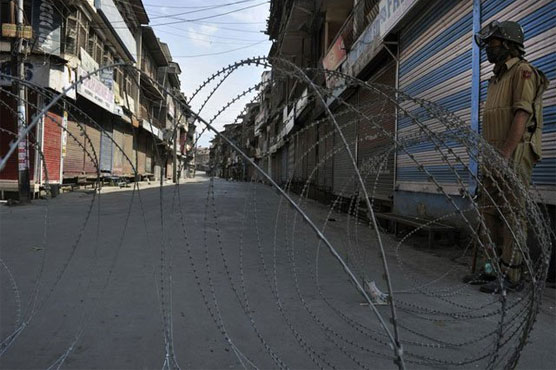
On fifth day of the violence, a complete strike is being observed all across the valley whereas curfew has also been imposed by the Indian authorities in order to prevent protests.
Hurriyet leaders are still under house arrest whereas All Parties Hurriyat Conference chairman Syed Ali Geelani has been arrested by the Indian forces.
Indian-held Kashmir’s main hospital struggled to treat hundreds of patients wounded in four days of clashes, as medics warned that many could lose their eyesight from shotgun injuries.
 Volunteers carry an injured boy shot during clashes between security forces and protesters in Srinagar
As the overall death toll from the violence rose to 34, ambulances continued to deliver more victims to Srinagar’s Sri Maharaja Hari Singh Hospital (SMHS) where patients were sometimes forced to share beds.
An administrator said staff had been ordered not to speak to the press but wards were crammed with young boys and men, many of whom had suffered serious eye injuries caused by the firing of pellets by Indian troops.
 Volunteers carry an injured man shot during clashes between security forces and protesters in Srinagar from an ambulance outside a hospital in the city
An AFP correspondent who toured the teeming wards saw two patients to a bed, as doctors worked non-stop.
"Doctors are working in operating theatres round-the-clock. We’ve operated on 90 for serious eye injuries since Saturday morning," said a doctor in SMHS where many volunteers were helping to tend to the injured.
 An Indian officer looks after clashes between security forces and protesters in Srinagar
"Most of them have lost their eyesight in one eye. They are going to walk out of the hospital as one-eyed boys," the doctor added.
One of the youngsters told AFP he had been injured when paramilitary troops opened fire towards him and a group of his friends with pellet guns as they walked out of a mosque in Srinagar on Friday evening.
 A couple with their child passes amid clashes between security forces and protesters in Srinagar
"I can’t see anything right now," the boy said, declining to give his name as he wiped away tears that were dripping out of the sides of his bandaged eyes.
A senior state administrator said at least 1,000 people have been injured in the clashes in Indian-held Kashmir, since alleged Hizbul Mujahideen commander Burhan Wani was killed last Friday.
 Security forces walk through the area in Srinagar
Much of the worst violence has been in the south of the capital Srinagar where security forces have used live fire, non-lethal pellet guns as well as tear gas to disperse crowds.
On Monday, hundreds of protesters tried to storm a military airbase about 25 kilometres (15 miles) south of Srinagar before being repelled.
 Protesters throw stones towards the security forces in Srinagar
While there were fresh clashes Tuesday, the violence was on a much smaller scale than previously. Two people died in hospital from injuries they had sustained earlier, raising the toll to 34.
The death of 22-year-old Wani, a poster boy for the region’s biggest separatist group, has sparked the deadliest clashes in occupied Kashmir since 2010 when massive demonstrations were held against Indian rule.
 Volunteers carry an injured man shot during clashes between security forces and protesters in Srinagar
Hizbul Mujahideen is one of several separatist groups which have been fighting for decades against the hundreds of thousands of Indian troops deployed in the disputed region.
Tens of thousands have died in the fighting since 1989.
Kashmir has been divided between rivals India and Pakistan since their independence from Britain in 1947, but both claim the picturesque Himalayan territory in its entirety.