Summary Polling stations are open all day to allow voters to cast their ballots before or after work
LONDON (AFP) - "It hasn t been this close in years, so obviously voting is very important," said Adam Banks, one of millions of voters for whom the uncertainty of Thursday s British election weighs heavily.
The 28-year-old cast his ballot before work in a north London school, one of thousands of venues transformed for the day into makeshift polling stations.
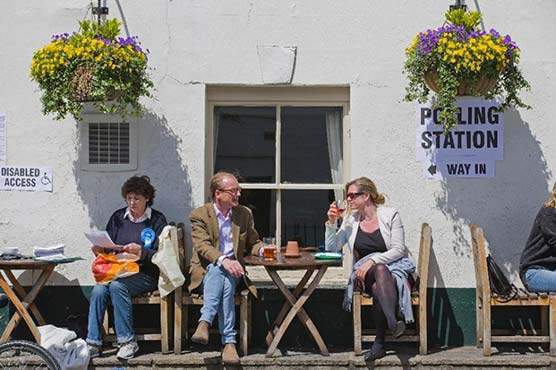
Pubs, churches, town halls and even a windmill are open until 10pm (2100 GMT), as voters choose their local member of the House of Commons in 650 different constituencies.
The party with the most seats will form a government, but at the end of an intense campaign, neither Prime Minister David Cameron s Conservatives nor opposition leader Ed Miliband s Labour party looked on course for an outright victory.
"It s been quite an exciting one. It s been a lot different from other elections we had because we don t know what the result is going to be," voter Josh Cook said at the north London school.
But for some, the lack of a certain outcome is troubling.
"I wouldn t say it s exciting -- it s more unnerving," said Annette, a 59-year-old community worker voting in south London, who declined to give her surname.
She only decided yesterday how to vote, after reading up on all the parties manifestos, but is still not clear exactly what they are all promising.
"In the past there s been a clear demarcation, where with each party you knew exactly where you stood. Whereas now, it s a shade of grey rather than red, or blue or green," she said.
- I ve done my duty -
If there is no clear winner, the Conservatives and Labour are likely to engage in protracted negotiations with smaller parties to try to form a government.
"The possible coalitions don t worry me," said Rachel, 35, voting the upmarket area of Kensington and Chelsea. "The issue that worries me most is taxes."
But James Donald, a communications manager voting in Dorset in the southwest of England, said he worried about how many of the promises made in the campaign would survive.
"I slightly dread the next few weeks of cattle dealing before we end up with whatever coalition manages to do the backroom deals," he said.
Donald did not think his vote would count for much, saying: "I will vote -- but more so I can feel I have done my duty and am part of the process."
The last election saw one of the lowest turnouts in decades, at 65 percent, and many people share Donald s views, particularly in seats where one party has a large majority.
"I don t think my vote will make a lot of difference," said Frank, an 86-year-old former serviceman at London s Royal Hospital Chelsea, a retirement home for veterans.
Looking smart in his blue military-style uniform, he said: "It s a toss-up between one who looks alright and a whole lot of lunatics. We are surrounded by nutters."
- Pub politics -
Polling stations are open all day to allow voters to cast their ballots before or after work -- elections are always held on a Thursday, although nobody really knows why.
Several theories have been advanced over the years, one being that Thursday was traditionally the day before payday -- and the day voters were least likely to be drunk.
The Anglesea Arms pub in west London is doubling up as a polling station this year, although the bar was closed to early morning voters.
"This vote is very important, it will impact our future in many ways," said Neiruz Gharret, emerging from the pub as two men in suits arrived in a taxi, jumped out to vote, and drove off again.
She added: "It s fun voting in a pub. I ll be back tonight looking forward to the election night."