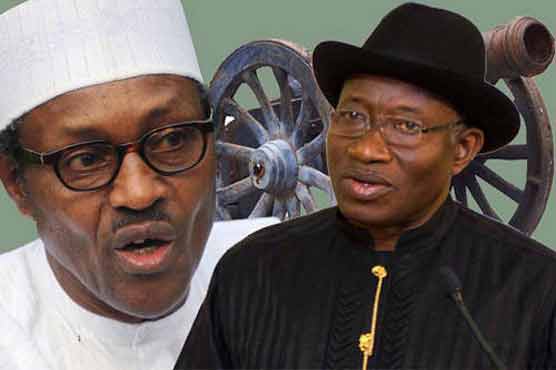
Summary President Jonathan was neck-and-neck with his main challenger Buhari in Nigeria's general election.
ABUJA (AFP) - President Goodluck Jonathan was neck-and-neck with his main opposition challenger in Nigeria s knife-edge general election on Monday, with tensions and fears of violence running high as results trickled in.
The presidential election pitting Jonathan against former military ruler Muhammadu Buhari is the closest in Nigeria s history, and the first with a credible opposition challenge.
International election observers gave broadly positive reactions to the conduct of the vote, despite late delivery of election materials and technical glitches with new voter authentication devices.
Nigeria s Transition Monitoring Group, which had observers across the country, said: "These issues did not systematically disadvantage any candidate or party."
Buhari and his All Progressives Congress (APC) won five states while Jonathan, of the Peoples Democratic Party (PDP), took three plus the Federal Capital Territory of Abuja.
But the 57-year-old Jonathan was marginally ahead on the overall number of votes won so far, with the next tranche of results expected later in the evening.
The PDP and the APC on Sunday traded allegations of vote rigging and other irregularities, raising the possibility of a legal challenge to the results.
Violence has often flared in previous Nigerian votes after the winner is announced and the United States and Britain warned against any "interference" with the count.
"So far, we have seen no evidence of systemic manipulation of the process," US Secretary of State John Kerry and British foreign minister Philip Hammond said in a joint statement.
"But there are disturbing indications that the collation process -- where the votes are finally counted -- may be subject to deliberate political interference."
Kayode Idowu, spokesman for the Independent National Electoral Commission (INEC), told AFP that there was "no evidence of political interference".
Jonathan s campaign spokesman Femi Fani-Kayode told reporters in Abuja that the claims were "absolutely balderdash" and challenged Kerry and any other foreign powers to provide evidence.
Nigeria s central Kaduna state, one of the areas worst-affected by violence four years ago when some 1,000 people were killed in post-election clashes, was said to be calm.
Awwal Abdullahi Aliyu, president of the Northern People Unity and Reconciliation Union, welcomed positive statements from foreign observers about the conduct of the election.
But he warned that places such as Kaduna remained a powderkeg, particularly if electoral fraud is suspected in any ruling party victory.
"If it does happen that it is declared that President Jonathan is the winner, not General Buhari, looking at what has happened so far in Nigeria at this election, I can tell you that Kaduna will catch fire," he said.
Some 2,000 women protesting against the conduct of the elections were teargassed as they tried to converge on the local electoral commission offices in the southern oil city of Port Harcourt.
The protest over alleged vote rigging by the PDP -- and a counter-protest demanding the results hold -- forced the Rivers state government to impose an overnight curfew.
The electoral commission is investigating the claims of electoral fraud.
Political parties have been urged to take any disputes to the courts rather than the streets.
Jonathan s PDP has been in power since Nigeria returned to civilian rule in 1999 but is being pushed to the wire by Buhari.
The prospect of a democratic transfer of power -- plus economic woes caused by the slump in global oil prices, concerns about corruption and fears about insecurity -- energised the vote.
The winning presidential candidate needs not just the most votes but at least 25 percent support in two-thirds of Nigeria s 36 states and the Federal Capital Territory to avoid a run-off.
Voting was pushed into an unscheduled second day Sunday after failures in controversial new technology designed to read biometric identity cards to combat electoral fraud.
Among those affected by the technical hitches was the president himself.
Some 348 polling stations had to open again on Sunday to complete the vote, for which 68.8 million people are registered out of Nigeria s population of 173 million.
But election chief Attahiru Jega said the number of affected devices was minimal and the commission was confident of meeting its goal of a "free, fair, credible and peaceful" election.
"We appeal to all Nigerians to remain peaceful as they await the return of these results," he told a news conference on Sunday.
Boko Haram has dominated the campaign, with military operations against the Islamist militants forcing a six-week delay to the scheduled February 14 election.
On Sunday, residents and a military source said soldiers supported by two fighter jets had intercepted militants at Dungulbe village, seven kilometres (four miles) from Bauchi city in the northeast.
A spokesman for the Bauchi state governor said a round-the-clock curfew had been imposed on three areas because of the fighting.
The militants were believed to have come through the town of Alkaleri, 60 kilometres away, where there was a dawn raid on Saturday.
A series of suspected attacks on polling stations in neighbouring Gombe state on Saturday killed at least seven.
Boko Haram leader Abubakar Shekau had vowed to disrupt the election, calling it "un-Islamic".