Summary Some 5.8 million people are eligible to vote in the election for Israel's 20th Knesset
JERUSALEM (AFP) - Israelis were voting Tuesday in a close-fought election pitting the centre left against Prime Minister Benjamin Netanyahu, who ruled out a Palestinian state in a last-ditch appeal to the far-right.
The outcome of the vote, in which polls indicate the centre-left Zionist Union will win the most seats, is likely to help determine the prospects for new Middle East peace talks and Israel s troubled relations with its US ally.
Some 5.8 million people are eligible to vote in the election for Israel s 20th Knesset, or parliament, which has 120 seats.
Voters have until 10:00 pm (2000 GMT) to cast their ballots and three hours into the voting, turnout stood at 13.7 percent.
Exit polls giving the first indications of the outcome are to be published just minutes after polling stations close.
On a cold but sunny morning, a handful of early voters turned up to cast their ballots at a polling station in Jerusalem which had bunting and the blue-and-white flag of the Zionist Union draped outside.
"I d like to see Netanyahu disappear for many, many years. The most important issue is relations with the Palestinians," said Shulamit Laron, a woman in her fifties.
"I hope for change, of course, but I doubt things will change."
In the mixed Jewish-Arab port city of Haifa, some 50 people were queing at a polling station in Ahmediya school where pictures of candidates from the Joint Arab List were hanging on the walls outside.
"This is the first time that I ve seen so many people here to vote," said Ehab Hamam, a 37-year-old Arab Israeli who works in hi-tech.
"For the Arabs, voting in this election is saying to the right: we are here," he said.
"I ve never seen such a long queue outside a polling station," agreed 73-year-old Gideon Leber, a Jewish Israeli voter.
- No Palestinian state -
========================
The vote is Israel s third election since 2009 and the biggest challenge yet for 65-year-old incumbent Netanyahu, who is seeking a third consecutive term.
Final opinion polls gave the Zionist Union of opposition Labour leader Isaac Herzog a three to four seat lead over Netanyahu s Likud.
Even if Likud comes second, Netanyahu will have a definite advantage over Herzog when it comes to piecing together a majority of at least 61 seats, thanks to the backing of rightwing and religious parties.
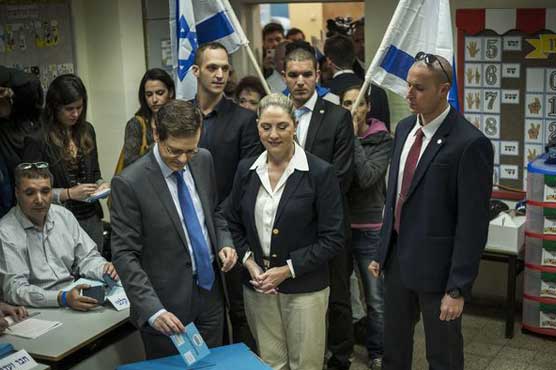
"Whoever wants to continue Bibi s way to despair and disappointment can vote for him, but whoever wants hope, change and truly a better future for Israel, should vote for the Zionist Union," Herzog said on casting his ballot in Tel Aviv, calling Netanyahu by his nickname.
Netanyahu has warned a vote for the Zionist Union could endanger Israel s security and lead to the division of Jerusalem and the establishment of a Palestinian state in the annexed eastern sector.
In a last-minute effort to garner votes from the hardline right, Netanyahu on Monday said there would be no Palestinian state established if he was reelected, effectively reneging on his endorsement of a two-state solution in a key speech in 2009.
Netanyahu s opponents charge that he has played the politics of fear and endangered Israel s close relationship with Washington for the sake of ideological posturing.
Washington accused his government of undermining US-brokered peace talks through its persistent expansion of settlements in the occupied territories.
- Historic day for Arabs -
============================
Analysts agree that the vote largely amounts to a referendum on Netanyahu s six years in power, with polls suggesting the Arab Israeli Joint List could win up to 13 seats, making it the third bloc in the Knesset.
"This is a historic day for the Arabs, today we are giving our answer to racism and to those who want to exclude us," Joint List leader Ayman Odeh told AFP as he left his home in Haifa to vote in a nearby school.
"When we have 15 MPs we will be able to influence the decision making, no one will be able to act without the third-largest party in parliament," he said.
"Tomorrow Netanyahu and the right will find themselves in opposition."
In Jerusalem, Moshe Simchovic, a 70-year-old veteran of the 1967 and 1973 wars, turned up to cast his vote wearing a keffiyeh, a traditional Palestinian headscarf.
Although the Israeli-Palestinian conflict was low on the priority list for most parties contesting the election, it was a key issue for many voters.
"I m voting for the Arab List, I m very leftwing," he told AFP.
"I m an ex-patriot. Israel changed after 1967, it s become fanatical and rightwing since then. Before, we were fighting for our lives but now we re the conqueror."
Another voter in her early 20s, who gave her name only as Natalie, said she had cast her ballot for Naftali Bennett s far-right Jewish Home party, which firmly opposes a Palestinian state.
"I m voting for Bennett, since he represents what I believe in: the importance of the state of Israel, and not giving any of it away to the Arabs."