Summary The meetings are the latest in a string of recent talks between the two men.
GENEVA (AFP) - Washington and Tehran s top diplomats sat down Monday for a second day of talks on Iran s nuclear programme as they struggled to narrow gaps ahead of a key deadline.
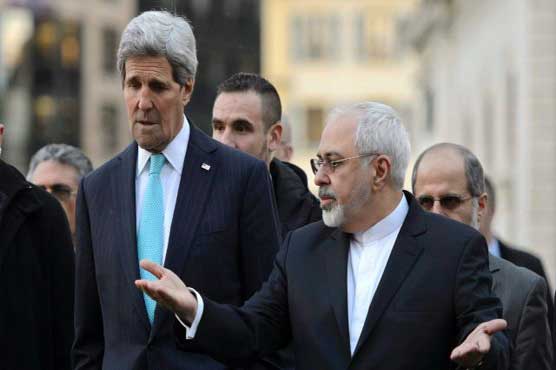
US Secretary of State John Kerry and his Iranian counterpart Mohammad Javad Zarif met for two and a half hours at a luxury Geneva hotel Sunday, and resumed their talks just after 9:30 am (0830 GMT) Monday.
The meetings are the latest in a string of recent talks between the two men in a bid to smooth the way towards a long-elusive nuclear deal.
World powers are trying to strike an accord with Iran that would prevent Tehran from developing a nuclear bomb in return for an easing of punishing international economic sanctions. Iran denies its nuclear programme has military objectives.
Tortuous negotiations over the controversy have poisoned relations between Iran and the West for years. However, there is now a heightened sense of urgency as the clock ticks down towards a March 31 deadline to agree on a political framework for the deal.
A senior State Department official said "a full schedule of meetings" was planned Monday with the participation of all the main negotiators and experts, touching on "virtually every topic."
"These meetings are steps in a long and tough process," the official said.
Key questions still unresolved
But Iran s Deputy Foreign Minister Abbas Araghchi, who is taking part in the discussions, said "key questions" remained unresolved.
"All parties are negotiating with seriousness and determination, but we haven t found solutions to key questions," he told Iranian state television late Sunday.
"The gap still exists, differences exist," he added.
Before the talks, Kerry also acknowledged that there were "still significant gaps. There is still a distance to travel."
US and Iranian diplomats have been meeting in Geneva since Friday, and senior negotiators from the so-called P5+1 group of Britain, China, France, Russia, the United States and Germany and held parallel negotiations with Tehran on Sunday to help drive the talks forward.
In a sign of the growing push for an accord, US Energy Secretary Ernest Moniz is taking part in the talks for the first time, as is Ali Akbar Salehi, the director of the Iranian Atomic Energy Organisation.
Both men led five hours of negotiations on Saturday, before Kerry s arrival, and took part in the discussions between the two top diplomats Sunday night and Monday morning.
Observers have suggested their participation could be a sign a deal is within reach.
But Kerry played down the importance of adding new negotiators to the mix, saying Moniz was present because of the "technical" nature of the discussions.
While the political aspects of the deal must be nailed down by the end of next month, the deadline for signing the full agreement is June 30 -- a cut-off point that looms all the larger after two previous deadlines were missed.
With both Washington and Tehran under pressure from hardliners at home eager to torpedo the deal, observers agree a new extension is unlikely.
Kerry himself warned Saturday that US President Barack Obama had "no inclination whatsoever to extend these talks beyond the period that has been set out."
Akbar Velayati, the diplomatic adviser to Iran s supreme leader Ayatollah Ali Khamenei, shot back Sunday that "if American leaders don t want to negotiate, it s up to them, but they were the ones who were after negotiations."
A key stumbling block in any final deal is thought to be the amount of uranium Iran would be allowed to enrich, and the number and type of centrifuges Tehran can retain.
Under an interim deal reached in November 2013, Iran s stock of fissile material has been diluted from 20 percent enriched uranium to five percent in exchange for limited sanctions relief.
Experts say such measures diminished Iran s ability to make an atomic weapon, which Tehran denies pursuing in the first place.