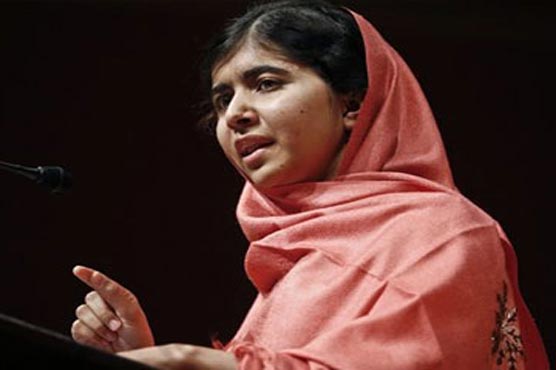
Summary Pakistani education activist Malala Yousafzai gives a press conference in Abuja.
Oslo (AFP) - The Nobel Peace Prize was awarded jointly Friday to 17-year-old Pakistani Malala Yousafzai, who survived being shot in the head by the Taliban, and to India s anti-child labour activist Kailash Satyarthi for their championing of children s rights.
Malala, the youngest ever Nobel laureate, heard the news while at school in Birmingham, England, where she was taken from Pakistan to receive life-saving treatment two years ago.
The Norwegian Nobel Committee said the duo had been chosen for their struggle against the repression of children and young people and "for the right of all children to education".
Kailash Satyarthi attends a human trafficking special session during the 2009 Clinton Global Initiative at the Sheraton New York Hotel & Towers in New York City on September 24, 2009
Malala, who had fought for years for the right of girls to go to school in her home region, leapt to global fame after the Taliban -- who oppose women s education -- tried to gun her down in October 2012.
Her campaign, the Nobel committee said, has been carried out "under the most dangerous circumstances".
"Through her heroic struggle she has become a leading spokesperson for girls’ rights to education," the committee said.
Pakistani schoolgirl Malala Yousafzai lies in her bed after receiving treatment at the Queen Elizabeth Hospital/University Hospitals in Birmingham on October 19, 2012
The selection of such a young winner was bound to be eye-catching, but another unusual aspect of this year s prize was the choice of citizens from the often warring neighbours of India and Pakistan. Seventeen civilians have been killed in the last few days in the Kashmir region, which the countries have long disputed, in the worst violence for decades.
- Malala pride of country -
Satyarthi, who founded a campaign in the 1980s to combat child labour in the carpet industry, said he was "delighted", calling the Nobel prize "recognition of our fight for child rights".
Indian children carry coal in baskets towards a coal crushing machine at a road side coal depot in the East Jaintia Hills district of the northeastern state of Meghalaya on January 30, 2013
The low-profile, 60-year-old activist heads the Global March Against Child Labor, which unites 2,000 social groups and union organisations in 140 countries. He is credited with helping tens of thousands of children forced into slavery by businessmen, landowners and others to gain their freedom.
"Something which was born in India has gone global and now we have a global movement against child labour," he told Indian television.
In Pakistan, Prime Minister Nawaz Sharif called Malala the "pride" of his country.
Pakistani security official stands guard as girls at a school in Mingora, a town in Swat valley on October 9, 2013
"She has made her countrymen proud. Her achievement is unparallelled and unequalled. Girls and boys of the world should take the lead from her struggle and commitment," he told AFP in a statement.
UN Secretary General Ban Ki-moon said the "true winners" of the prize were "the world s children".
Pakistani civil society activists carry placards with a photograph of the gunshot victim Malala Yousafzai as they shout ant-Taliban slogans during a protest rally in Islamabad on October 10, 2012
"With her courage and determination, Malala has shown what terrorists fear most: a girl with a book," he said.
German Chancellor Angela Merkel said it was "a good day for the world s children."
The head of the UN educational organisation, UNESCO, praised both winners, saying the awarding of the peace prize "sends out a resounding message to the world on the importance of education for building peaceful and sustainable societies."
"Kailash Satyarthi is a close friend of UNESCO and has been at the forefront of the global movement to end child slavery and exploitative child labour since 1980," UNESCO Director-General Irina Bokova said.
"Malala stands with us in the struggle for universal education, especially for girls," Bokova said.
The chairman of the Norwegian Nobel Committee, Thorbjoern Jagland, said Malala s youth was not a factor in awarding the prize.
"Our consideration has been to highlight the young who have stood up... and the old who have worked for years against child labour and for children s rights," he said.
"We noticed that she has received a long line of other prizes... The most important thing in the fight against extremism is to give young people hope," he added.
Since her brush with death, Malala has become an international star. She received a standing ovation in July 2013 for an address to the United Nations General Assembly in which she vowed she would never be silenced.