Summary Tayyip Erdogan won presidential elections on August 10 with almost 52 percent.
ANKARA (AFP) - Turkey s outgoing premier Recep Tayyip Erdogan was sworn in as president on Thursday to extend his more than decade-long dominant rule of the country.
Taking over Erdogan s post of prime minister is Foreign Minister Ahmet Davutoglu, 55, a long standing ally who is expected to do little to challenge the Turkish number one.
Erdogan has made clear he wants to wield genuine executive power as president, unlike recent predecessors in the Cankaya presidential palace who performed a largely ceremonial role.
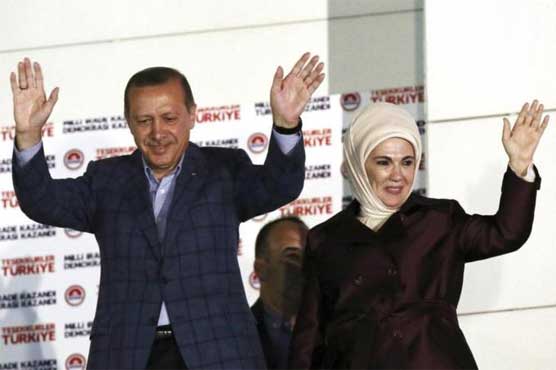
Erdogan, who became prime minister in 2003, won presidential elections on August 10 with almost 52 percent, the first time Turkey has elected its president in a popular vote.
The election was a triumph for Erdogan and the ruling Justice and Development Party (AKP) after surviving a tumultuous 2013 that saw deadly anti-government protests and corruption allegations against his circle.
He will take over as president from Abdullah Gul, a former close comrade and co-founder of the AKP who appears now to have fallen out with the feisty Erdogan and is expected to play no role in the next government.
Heads of state from a dozen nations in Eastern Europe, Africa, Central Asia and the Middle East will attend the ceremony, including Ukraine s President Petro Poroshenko, the Anatolia news agency reported.
But leaders of top Western states will be conspicuous by their absence in a possible sign of suspicion towards Erdogan s authoritarian tendencies. The United States is only sending its charge d affaires in Ankara.
- Above the law -
A man clearly with his eye on history, Erdogan during his five-year presidential term will have ruled Turkey longer than its modern founder Mustafa Kemal Ataturk, who established the republic out of the ruins of the Ottoman Empire.
He can serve two mandates and so could stay in power until 2024, which would allow him to see in the 100th anniversary of modern Turkey in 2023 and portray himself as a historic figure rivalling Ataturk.
"The birthday of a new Turkey," headlined the staunchly pro-Erdogan Yeni Safak daily.
Erdogan has made clear he wants to press on with a mind-boggling programme of infrastructure projects including a mammoth new airport in Istanbul, a new ship canal in the city and a high speed rail network for the whole country.
When he takes his oath of office, Erdogan will swear to "abide by the constitution, the rule of law, democracy, the principles of the secular Republic".
But opponents have accused Erdogan of seeking to undermine Ataturk s legacy with authoritarian tendences and imposing a creeping Islamisation on society.
Controversially, he wants parliament after 2015 legislative elections to change the constitution to invest the presidency with more powers.
"We are faced with a man who places himself above the law and does not abide by any rule. But this kind of mentality is unacceptable," said Kemal Kilicdaroglu, leader of the opposition Republican People s Party (CHP).
Under Turkish law, the president should sever all ties with political parties -- but Kilicdaroglu said Erdogan had no intention of distancing himself from the AKP.
"This is a clear attack on the state s honour and dignity."
- Mission is the same -
Davutoglu was confirmed as party leader Wednesday at a vast meeting of the AKP at which both men vowed there would be no change in policy, despite the changeover.
"Names have no importance. Names change today but our essence, our mission, our spirits, our goals and ideals remain in place," Erdogan told the meeting.
Erdogan, however, insisted that Davutoglu would be a figure of real stature and would not be a "caretaker".
Davutoglu will form a new cabinet by Friday, with intense speculation over who will hold the top jobs with the head of Turkey s intelligence service Hakan Fidan a possible new foreign minister.
Davutoglu, who became foreign minister in 2009, is a controversial figure blamed by some for pursuing an over-ambitious foreign policy that led to the rise of Islamic militants in Syria.